
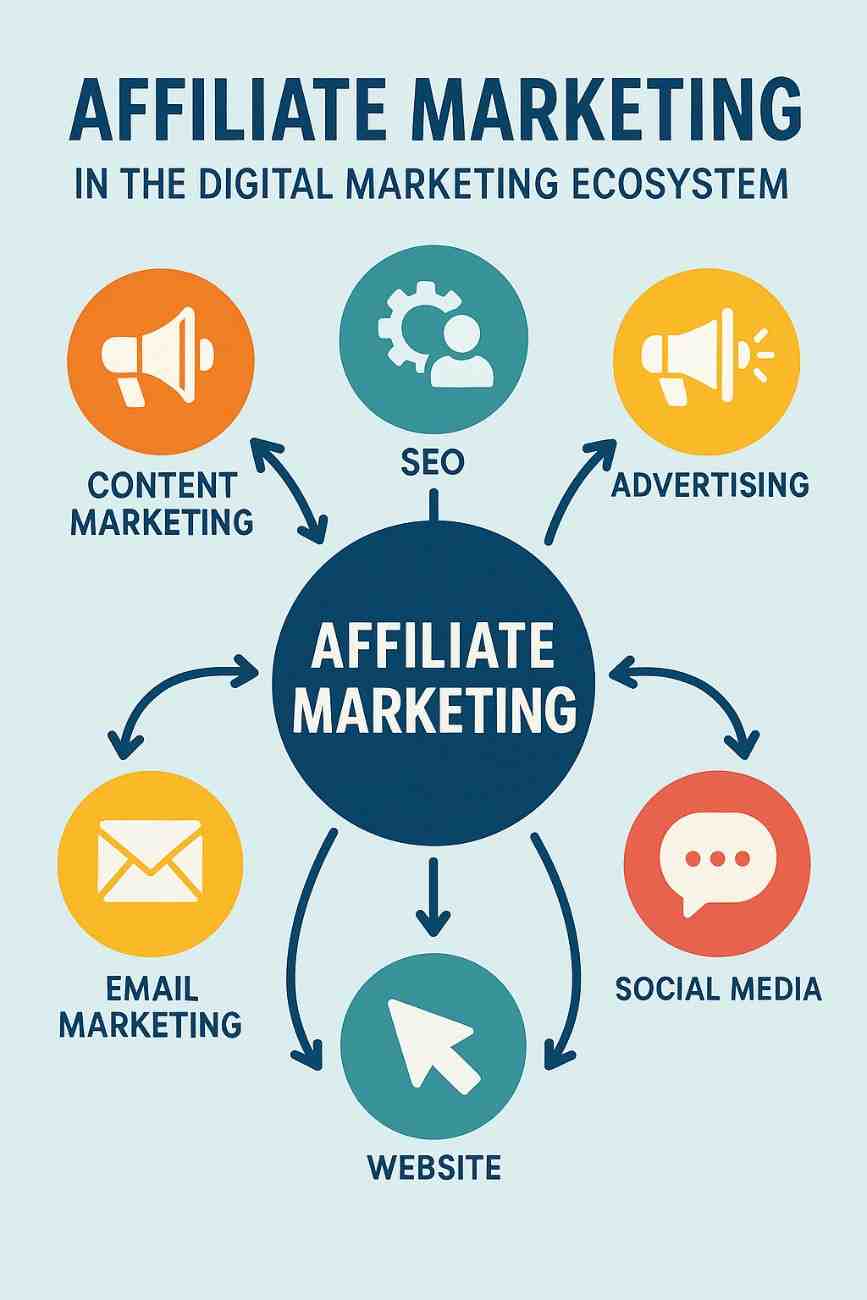
How Affiliate Marketing Fits into the Digital Marketing Ecosystem
Affiliate marketing is a performance-based marketing strategy that has become an integral component of the digital marketing ecosystem. It operates as a symbiotic relationship between merchants, affiliates, and consumers, enabling businesses to expand their reach while providing affiliates with opportunities to earn commissions. By aligning with other digital marketing channels and leveraging technology, affiliate marketing enhances brand visibility, drives conversions, and delivers measurable results. This essay explores how affiliate marketing fits into the broader digital marketing ecosystem, examining its role, synergies with other strategies, benefits, challenges, and real-world applications, with a detailed example to illustrate its practical integration.
Understanding Affiliate Marketing
Affiliate marketing involves three primary stakeholders: the merchant (the business selling a product or service), the affiliate (the promoter who markets the merchant’s offerings), and the consumer (the end user). Affiliates earn commissions by driving specific actions, such as sales, leads, or clicks, through their promotional efforts, typically using unique tracking links. These actions are tracked via affiliate networks (e.g., Amazon Associates, ShareASale) or in-house programs, ensuring accurate attribution and payouts.
Unlike traditional advertising, affiliate marketing is performance-driven, meaning merchants pay only for successful outcomes. This low-risk, high-reward model makes it a versatile tool within the digital marketing ecosystem, complementing strategies like search engine optimization (SEO), content marketing, social media marketing, email marketing, and paid advertising.
The Digital Marketing Ecosystem
The digital marketing ecosystem encompasses all online strategies and channels businesses use to attract, engage, and convert customers. Key components include:
- SEO: Optimizing websites to rank higher on search engines like Google.
- Content Marketing: Creating valuable content (e.g., blogs, videos) to educate and engage audiences.
- Social Media Marketing: Leveraging platforms like Instagram, X, and LinkedIn to build brand awareness.
- Email Marketing: Using targeted email campaigns to nurture leads and drive conversions.
- Paid Advertising: Running ads on platforms like Google Ads, Meta Ads, or programmatic networks.
- Influencer Marketing: Partnering with influencers to promote products to their followers.
- Analytics and Data: Using tools like Google Analytics to measure performance and optimize campaigns.
Affiliate marketing integrates seamlessly with these components, acting as a bridge that connects promotional efforts with measurable outcomes. Its flexibility allows it to amplify the effectiveness of other channels while providing unique advantages.
The Role of Affiliate Marketing in the Ecosystem
Affiliate marketing serves multiple functions within the digital marketing ecosystem, making it a versatile and scalable strategy.
- Performance-Based Revenue Generation:
- Affiliate marketing aligns with the ecosystem’s focus on ROI. Merchants pay commissions only when desired actions occur, ensuring cost-effectiveness.
- This performance-driven model contrasts with channels like display advertising, where costs are incurred regardless of outcomes.
- Expanded Reach and Brand Awareness:
- Affiliates, ranging from bloggers to influencers to niche websites, extend a merchant’s reach to diverse audiences.
- By tapping into affiliates’ established trust and credibility, brands gain access to targeted markets that may be difficult to reach through traditional channels.
- Synergy with Content-Driven Strategies:
- Affiliate marketing thrives on content, such as product reviews, tutorials, or comparison guides, which aligns with content marketing and SEO goals.
- Affiliates often create evergreen content that drives organic traffic over time, enhancing a brand’s visibility on search engines.
- Scalable Customer Acquisition:
- Affiliate programs allow merchants to scale customer acquisition without significant upfront costs, as affiliates bear the promotional expenses.
- This scalability complements paid advertising, where budgets limit reach, by leveraging affiliates’ organic or paid efforts.
- Data-Driven Optimization:
- Affiliate networks provide detailed analytics on clicks, conversions, and commissions, enabling merchants and affiliates to optimize campaigns.
- This data integrates with broader marketing insights, informing strategies across channels like email marketing or social media.
Synergies with Other Digital Marketing Channels
Affiliate marketing’s strength lies in its ability to complement and enhance digital marketing strategies, creating a cohesive ecosystem.
- SEO and Content Marketing:
- Affiliates often rely on SEO-optimized content, such as blog posts or YouTube videos, to drive traffic to merchant websites. For example, a blogger reviewing fitness equipment might target keywords like “best treadmills 2025,” boosting both their own and the merchant’s search rankings.
- Merchants benefit from backlinks generated by affiliate content, improving their domain authority and organic visibility.
- Social Media Marketing:
- Affiliates use platforms like Instagram, TikTok, or YouTube to promote products, aligning with social media marketing’s focus on engagement. An influencer sharing an affiliate link in a product demo video leverages their audience’s trust to drive conversions.
- Merchants can amplify affiliate efforts by providing branded content or running parallel social media campaigns.
- Email Marketing:
- Affiliates integrate affiliate links into email campaigns, promoting products to subscribers. For instance, a newsletter featuring software recommendations might include affiliate links to SaaS tools.
- Merchants can support affiliates by providing email templates or exclusive offers, enhancing conversion rates.
- Paid Advertising:
- Some affiliates use paid ads (e.g., Google Ads or Meta Ads) to promote affiliate links, complementing merchants’ paid campaigns. This requires careful coordination to avoid bidding competition.
- Merchants benefit from affiliates’ targeted ad spend, which extends their reach without additional budget.
- Influencer Marketing:
- Influencers often participate in affiliate programs, blending influencer and affiliate marketing. A beauty influencer promoting a skincare brand via an affiliate link combines authentic storytelling with trackable results.
- This synergy enhances trust and conversions, as influencers’ recommendations carry significant weight.
Benefits of Affiliate Marketing in the Ecosystem
Affiliate marketing offers unique advantages that enhance its fit within the digital marketing landscape.
- Cost-Effectiveness:
- Merchants pay only for results, minimizing financial risk compared to channels like paid ads or sponsorships.
- Affiliates bear promotional costs, allowing merchants to allocate budgets elsewhere.
- Trust and Credibility:
- Affiliates with established audiences (e.g., bloggers, YouTubers) lend credibility to merchants, as consumers trust recommendations from familiar sources.
- This trust amplifies conversion rates, especially for high-ticket or subscription-based products.
- Flexibility and Diversity:
- Affiliate marketing spans industries, from e-commerce to SaaS to financial services, and supports various commission models (e.g., one-time, recurring).
- Affiliates use diverse channels (blogs, social media, email), ensuring broad coverage within the ecosystem.
- Measurable Results:
- Advanced tracking technology provides granular data on performance, enabling precise optimization.
- This aligns with the ecosystem’s emphasis on data-driven decision-making.
- Passive Income for Affiliates:
- Affiliates benefit from recurring commissions or evergreen content, creating sustainable income streams.
- This incentivizes long-term partnerships, benefiting both affiliates and merchants.
Challenges of Affiliate Marketing in the Ecosystem
Despite its strengths, affiliate marketing faces challenges that impact its integration into the digital marketing ecosystem.
- Tracking and Attribution Issues:
- Cookie-based tracking can be disrupted by ad blockers, browser privacy settings, or cookie expiration, leading to lost commissions.
- Cross-device tracking remains a challenge, as consumers may click affiliate links on one device but convert on another.
- Competition and Saturation:
- Popular niches (e.g., tech, finance) attract numerous affiliates, increasing competition and requiring sophisticated strategies.
- Merchants may struggle to attract high-quality affiliates in crowded markets.
- Fraud and Compliance:
- Fraudulent activities, such as fake clicks or sales, can undermine program integrity.
- Affiliates must comply with regulations (e.g., FTC disclosure rules) and merchants’ terms, which can vary across programs.
- Dependency on Affiliates:
- Merchants rely on affiliates’ promotional efforts, which may lead to inconsistent results if affiliates underperform.
- Poor-quality affiliates (e.g., those using spammy tactics) can harm brand reputation.
- Program Management:
- Running an affiliate program requires resources for tracking, reporting, and affiliate support.
- Merchants must balance commission rates to attract affiliates while maintaining profitability.
Example of Affiliate Marketing in the Ecosystem
To illustrate affiliate marketing’s role, consider a hypothetical scenario involving a SaaS company and an affiliate.
Scenario: “GrowEasy,” a SaaS platform offering email marketing tools, launches an affiliate program through the ShareASale network, offering a 30% recurring commission on subscriptions. Sarah, a digital marketing blogger, joins the program to promote GrowEasy to her audience of small business owners.
Integration Across Channels:
- Content Marketing and SEO:
- Sarah writes a blog post titled “Top Email Marketing Tools for Small Businesses in 2025,” featuring GrowEasy. She optimizes the post for keywords like “best email marketing software,” driving organic traffic.
- The post includes her affiliate link, and backlinks to GrowEasy’s site improve its SEO.
- Social Media Marketing:
- Sarah shares the blog post on her X account and Instagram, posting a short video demo of GrowEasy’s features with her affiliate link in her bio.
- GrowEasy retweets Sarah’s post, amplifying its reach to their followers.
- Email Marketing:
- Sarah sends a newsletter to her 5,000 subscribers, highlighting GrowEasy’s benefits and including her affiliate link. She offers a downloadable guide on email marketing as a lead magnet, linking to GrowEasy’s trial.
- GrowEasy provides Sarah with a branded email template, ensuring consistent messaging.
- Paid Advertising:
- Sarah runs a small Google Ads campaign targeting “email marketing software,” directing clicks to her blog post. She ensures compliance with GrowEasy’s ad policies.
- GrowEasy’s own Meta Ads campaign complements Sarah’s efforts, targeting similar audiences.
- Results:
- Sarah’s blog post generates 50 trial signups, with 20 converting to paid subscriptions at $50/month. Her 30% commission yields $300/month in recurring income ($15 x 20).
- GrowEasy gains $1,000/month in revenue ($50 x 20) while paying $300 in commissions, achieving a positive ROI.
- Sarah’s content continues driving traffic, and GrowEasy’s brand visibility grows through her multi-channel promotion.
Analysis: This example shows how affiliate marketing integrates with SEO, content, social media, email, and paid ads to create a cohesive strategy. Sarah’s efforts amplify GrowEasy’s reach, while GrowEasy’s support (e.g., templates, retweets) enhances her success, demonstrating mutual benefits within the ecosystem.
Future Trends and Evolution
Affiliate marketing continues to evolve within the digital marketing ecosystem, driven by technological advancements and consumer behavior shifts:
- AI and Personalization: AI tools enable affiliates to create hyper-targeted content and merchants to optimize affiliate programs based on predictive analytics.
- Mobile and App-Based Affiliate Marketing: With increasing mobile usage, affiliate programs are adapting to app-based tracking and promotions.
- Privacy Regulations: Stricter laws (e.g., GDPR, CCPA) are pushing merchants toward cookieless tracking solutions, such as server-side tracking or first-party data.
- Micro-Influencers and Niche Affiliates: Brands are partnering with smaller, niche-focused affiliates for higher engagement and trust.
- Integration with Emerging Platforms: Affiliates are exploring new platforms like TikTok, Discord, or Web3 ecosystems to reach younger audiences.
Conclusion
Affiliate marketing is a vital pillar of the digital marketing ecosystem, offering a performance-based, scalable, and synergistic approach to customer acquisition. By integrating with SEO, content marketing, social media, email, and paid advertising, it amplifies brand reach and drives conversions while providing affiliates with sustainable income opportunities. Its benefits—cost-effectiveness, credibility, and measurability—make it a cornerstone strategy, though challenges like tracking issues and competition require careful management. The example of Sarah and GrowEasy illustrates how affiliate marketing leverages multiple channels to achieve mutual success, underscoring its adaptability and value. As technology and consumer preferences evolve, affiliate marketing will remain a dynamic and essential component of digital marketing, shaping the future of online commerce.

