
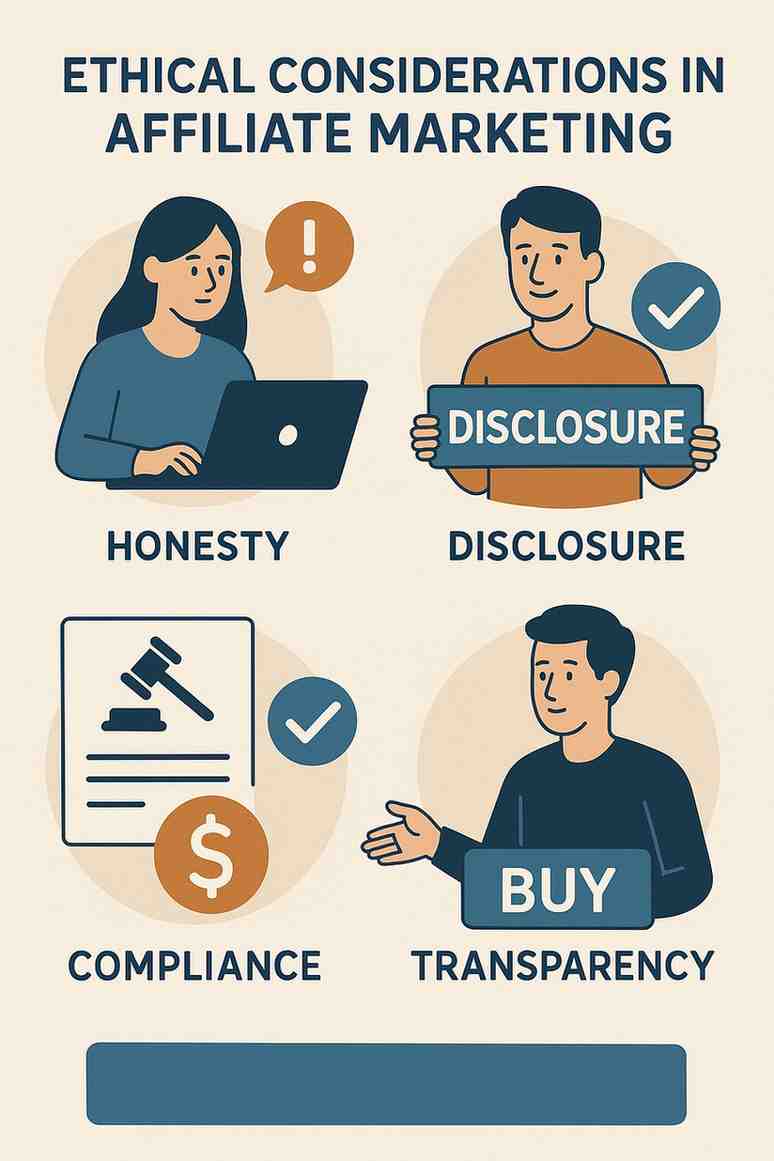
Ethical Considerations in Affiliate Marketing
Affiliate marketing is one of the most powerful and widely used strategies in the digital marketing world. It enables businesses to expand their reach through third-party partners (affiliates) who promote products or services in exchange for commissions. While the model is cost-effective and performance-based, it also opens the door to numerous ethical challenges. If not properly addressed, these issues can damage consumer trust, brand reputation, and the credibility of the affiliate marketing industry as a whole.
In this detailed discussion, we will explore the key ethical considerations in affiliate marketing, why they matter, how unethical practices can harm stakeholders, and how marketers can build ethical, trustworthy programs. We will also include real-world examples to illustrate both positive and negative ethical practices.
Table of Contents
Toggle1. What Is Ethics in Affiliate Marketing?
In the context of affiliate marketing, ethics refers to the principles and standards that guide affiliates and merchants in conducting honest, fair, and transparent promotional activities. This includes how products are advertised, how commissions are disclosed, how data is handled, and how consumers are treated.
Ethical affiliate marketing ensures that:
-
Consumers are not misled
-
Affiliates disclose relationships
-
Honest reviews are shared
-
User privacy is respected
-
All parties act with integrity
2. Why Are Ethics Important in Affiliate Marketing?
Affiliate marketing is built on trust — trust between the consumer and the affiliate, between the affiliate and the merchant, and between the consumer and the brand. If any of these trust bonds are broken due to unethical behavior, the entire marketing ecosystem suffers.
Consequences of Unethical Affiliate Marketing:
-
Loss of customer trust
-
Damage to brand reputation
-
Affiliate bans from programs or networks
-
Legal actions and regulatory fines
-
Decrease in conversion and engagement rates
Therefore, ethical practices are not just about “doing the right thing”; they are also essential for long-term sustainability and business success.
3. Major Ethical Considerations in Affiliate Marketing
a. Full Disclosure and Transparency
One of the most fundamental ethical principles in affiliate marketing is disclosing affiliate relationships. When an affiliate promotes a product and earns a commission on purchases, they are ethically (and legally) required to inform their audience.
Why It Matters:
Consumers deserve to know when a recommendation might be influenced by compensation. Transparency builds trust.
What Ethical Disclosure Looks Like:
-
“This post contains affiliate links. If you purchase through them, I may earn a commission at no extra cost to you.”
-
Including a visible disclosure at the beginning of blogs, videos, or emails.
Regulatory Guidelines:
The Federal Trade Commission (FTC) in the U.S. mandates clear and conspicuous disclosure of affiliate relationships. Violations can lead to fines and penalties.
✅ Ethical Example:
A tech YouTuber promoting a laptop includes this statement in their video and description:
“This video contains affiliate links. I may earn a small commission if you buy through them, which helps support my channel.”
b. Honest and Accurate Product Representation
Affiliates should provide genuine and accurate information about the products they promote. Making false claims or exaggerating product benefits to drive sales is unethical.
Unethical Examples:
-
Claiming a weight-loss supplement is “clinically proven” when it’s not
-
Promoting a software as “free forever” when it’s only free for 7 days
Ethical Practice:
-
Using the product before reviewing it
-
Highlighting both pros and cons
-
Avoiding hype and deception
✅ Example:
An affiliate marketer who reviews a course writes:
“This course has great content for beginners, but if you’re an advanced learner, it might be too basic.”
c. Spamming and Deceptive Practices
Using spammy tactics like mass unsolicited emails, fake landing pages, or clickbait headlines is not only unethical but also illegal in many jurisdictions.
Common Unethical Tactics:
-
Sending affiliate links to random people via WhatsApp or email without consent
-
Redirecting users to unrelated pages just to earn a click
-
Faking scarcity (“Only 1 item left!”) when it’s not true
Ethical Approach:
-
Using permission-based marketing (opt-in emails, respectful popups)
-
Creating value-driven content that naturally includes affiliate links
-
Maintaining transparency about promotions
d. Cookie Stuffing
Cookie stuffing is a black-hat technique where affiliates secretly drop tracking cookies on users’ browsers without their knowledge or consent. This makes it appear as if the affiliate referred the user when they didn’t, stealing commission unfairly.
Example of Unethical Cookie Stuffing:
An affiliate embeds invisible code on their website that sets cookies for multiple products even when the user didn’t click any links.
Ethical Solution:
Ensure cookies are only set when a user intentionally clicks on a clearly labeled affiliate link.
❌ Legal Risk:
Many affiliate programs and networks have strict policies against cookie stuffing. Violators are banned and may face legal consequences.
e. Respect for User Privacy
Affiliates and merchants must respect data privacy laws like GDPR (EU) and CCPA (California). This includes getting consent before collecting user data and being transparent about how it’s used.
Unethical Behaviors Include:
-
Collecting emails without user permission
-
Using affiliate pixels to track users without consent
Ethical Standards:
-
Display clear cookie consent banners
-
Provide privacy policies
-
Avoid unnecessary data collection
f. Fair Attribution and Commission Sharing
Sometimes, dishonest affiliates use unethical methods to steal credit from other affiliates. This is known as affiliate hijacking or commission theft.
Example:
Affiliate A refers a customer to a product, but Affiliate B uses a coupon code popup or last-minute redirect to overwrite the tracking cookie.
Ethical Practices:
-
Allowing fair commission attribution
-
Avoiding aggressive last-click strategies
-
Respecting other affiliates’ promotional efforts
g. Promoting Relevant and Valuable Products
Affiliates should only promote products that are relevant to their audience and genuinely valuable. Promoting unrelated or low-quality products for quick commissions can harm both the affiliate’s credibility and the user experience.
✅ Ethical Example:
A parenting blogger promotes eco-friendly baby products they use personally.
❌ Unethical Example:
The same blogger promotes gambling apps just for high commission payouts.
4. Case Study: Amazon Associates Ethical Controversy
In 2021, some affiliates of Amazon Associates were penalized or banned due to unethical behavior:
-
They used fake reviews to boost sales.
-
Some embedded affiliate links in ads without proper disclosure.
-
A few used coupon sites to overwrite cookies, stealing commissions.
Amazon tightened its affiliate guidelines and removed thousands of accounts, illustrating the importance of compliance and ethical practices.
5. Best Practices for Ethical Affiliate Marketing
To maintain credibility and long-term success, affiliates and merchants should follow these best practices:
✅ For Affiliates:
-
Always disclose affiliate links clearly
-
Promote products you believe in or have used
-
Avoid overhyping or misleading claims
-
Use honest reviews and comparisons
-
Respect your audience’s privacy
-
Use legal and compliant tracking tools
✅ For Merchants:
-
Vet affiliates carefully
-
Provide ethical guidelines and training
-
Use anti-fraud tracking systems
-
Reward transparency and honesty
-
Monitor affiliate activity regularly
6. Benefits of Ethical Affiliate Marketing
When affiliates and merchants operate ethically, everyone benefits:
a. Builds Long-Term Trust
Trustworthy content leads to loyal followers, better engagement, and sustainable commissions.
b. Protects Brand Reputation
Ethical marketing reflects well on both the affiliate and the brand, attracting more customers and partners.
c. Reduces Legal Risk
Compliance with regulations like the FTC’s guidelines or GDPR helps avoid costly penalties.
d. Attracts Quality Partnerships
Ethical affiliates attract reputable merchants, and ethical merchants attract professional affiliates.
Conclusion
Ethical considerations in affiliate marketing are not optional — they are essential for maintaining a trustworthy and sustainable ecosystem. As the digital landscape grows more competitive and consumers become more informed, transparency, honesty, and respect for privacy are vital.
Whether you’re an affiliate promoting a product or a merchant managing a program, your long-term success will depend on your ethical integrity. The industry thrives when everyone plays fairly. Ethical affiliate marketing builds a better internet — one that rewards effort, honesty, and trust.
Final Example Recap:
Ethical Affiliate Marketer (Riya):
-
Runs a food blog
-
Reviews cooking appliances she’s tested
-
Clearly discloses affiliate links
-
Offers both pros and cons
-
Collects emails only via opt-in forms
-
Promotes only products relevant to her audience
Result:
Her audience trusts her, brands value her professionalism, and she earns sustainable income.
By focusing on ethical practices, affiliates like Riya become not only successful marketers but also respected voices in the digital community.
You said:
ChatGPT said:
It seems your message was accidentally repeated or incomplete:
“Explain in not less than 1200 words” “and give an appropriate example. “and give an appropriate example.
Could you please clarify the topic or question you’d like me to explain in detail? For example, are you looking for an explanation on a topic related to affiliate marketing, digital marketing, SEO, e-commerce, or something else entirely?
Once I have the correct topic, I’ll be happy to provide a complete, 1200+ word explanation with examples.
You said:
ChatGPT said:
How Can a Beginner Start Affiliate Marketing Step-by-Step?
With a Practical Example
Affiliate marketing is one of the most accessible and profitable ways to make money online, even if you’re a complete beginner. With minimal startup costs and a wide range of niches to choose from, it offers an excellent opportunity to earn passive income by promoting other people’s products. However, while it’s easy to enter, succeeding in affiliate marketing requires planning, patience, consistency, and the right strategies.
In this comprehensive guide, we’ll walk through step-by-step instructions for beginners to start affiliate marketing from scratch — along with a real-world example to illustrate how it works in practice.
What Is Affiliate Marketing? (Quick Recap)
Affiliate marketing is a performance-based marketing model where a person (the affiliate) earns a commission by promoting a product or service and encouraging others to purchase it through their unique affiliate link.
You don’t have to create your own product. Instead, you earn money every time someone clicks your link and performs a specific action — usually a purchase or a signup.
Step-by-Step Guide for Beginners
Step 1: Choose a Niche
Your niche is the specific topic or category you’ll focus on. Picking the right niche is crucial because it determines your audience, your content, and the products you’ll promote.
✅ How to Choose a Good Niche:
-
Interest or passion – Choose something you enjoy (e.g., fitness, cooking, gaming).
-
Profitability – Make sure there are affiliate products with decent commissions.
-
Search demand – Use tools like Google Trends or Ubersuggest to see if people are interested in your niche.
-
Low-to-moderate competition – Avoid overly saturated markets unless you have a unique angle.
🎯 Example:
Suppose you’re passionate about home fitness — that can be your niche. You can promote home gym equipment, workout apps, or nutrition supplements.
Step 2: Research and Join Affiliate Programs
Once you’ve chosen your niche, the next step is to find relevant affiliate programs to join.
🔍 Where to Find Affiliate Programs:
-
Affiliate networks (like ShareASale, CJ Affiliate, Impact, ClickBank)
-
Individual brand websites (e.g., Nike, Amazon, Bluehost)
-
Google search: Just type “Your niche + affiliate program” (e.g., “home fitness affiliate program”)
🔗 What to Look For in a Program:
-
Good commission rates (20%+ is great; some offer recurring commissions)
-
Reliable tracking and reporting
-
Reasonable payment threshold and payment methods
-
Product quality and reputation
🎯 Example:
In the home fitness niche, you might join:
-
Amazon Associates to promote home gym gear
-
ClickBank for fitness courses or apps
-
MyProtein or Onnit for supplements
Step 3: Choose a Platform to Promote Products
You need a platform to share your affiliate links and reach your audience. Beginners can choose from several free or low-cost platforms:
🌐 Options Include:
-
Blog or Website – Great for long-term content like reviews, guides, and comparisons.
-
YouTube Channel – Ideal for product demos, tutorials, and visual content.
-
Instagram or TikTok – Good for lifestyle niches (fitness, fashion, food).
-
Email Newsletter – Build an email list and promote directly to subscribers.
You don’t have to be on all platforms — start with one where your target audience is most active.
🎯 Example:
You start a blog called FitHomeNow.com, where you review workout gear, post exercise tips, and link to affiliate products.
Step 4: Create Valuable, SEO-Friendly Content
Now that you have a niche, affiliate programs, and a platform, it’s time to create content that educates, entertains, or solves problems — and includes your affiliate links.
📝 Types of Content:
-
Product reviews
-
“Best of” or comparison lists (e.g., “Top 5 Treadmills for Small Spaces”)
-
Tutorials or how-tos (e.g., “How to Set Up a Home Gym Under ₹15,000”)
-
Informational posts (e.g., “Benefits of Resistance Training at Home”)
Use SEO (Search Engine Optimization) techniques to help your content rank in Google:
-
Target relevant keywords (use tools like Ubersuggest or SEMrush)
-
Use catchy titles
-
Add value with detailed, helpful information
-
Include internal and external links
🎯 Example:
You write a blog post: “Best Adjustable Dumbbells for Home Workouts (2025 Buyer’s Guide)” and include your Amazon affiliate links to products like Bowflex or PowerBlock dumbbells.
Step 5: Drive Traffic to Your Content
Even the best content won’t earn commissions unless people see it. You need to drive targeted traffic to your affiliate links.
🔄 Free Traffic Strategies:
-
SEO (Google search traffic)
-
Social media (Instagram reels, Pinterest pins, Facebook groups)
-
YouTube videos
-
Quora or Reddit answers
-
Guest blogging
🚀 Paid Traffic Options (Advanced):
-
Facebook/Instagram ads
-
Google search ads
-
Pinterest promoted pins
Start with organic traffic if you’re a beginner. Focus on building content that ranks on Google and attracts visitors over time.
🎯 Example:
You optimize your article for the keyword “best dumbbells for home gym India” and it starts appearing on the first page of Google, bringing in 100 visitors a day.
Step 6: Build Trust with Your Audience
People only buy from affiliates they trust. Building that trust takes time, but it’s essential for long-term success.
🤝 How to Build Trust:
-
Be honest in reviews (include pros and cons)
-
Disclose affiliate relationships (e.g., “This post contains affiliate links…”)
-
Share your personal experience with products
-
Provide free value before asking for sales
-
Engage with your audience through comments, emails, or DMs
🎯 Example:
You create a video demo of resistance bands you personally use, show how they work, and offer your honest opinion. Viewers appreciate the transparency and are more likely to buy through your link.
Step 7: Track Results and Optimize
To grow your affiliate income, track what’s working and optimize your strategy.
📊 Tools to Use:
-
Google Analytics – See which content is driving traffic
-
Affiliate dashboards – Check clicks, conversions, and commissions
-
Heatmaps (like Hotjar) – Understand where users click
🔄 What to Optimize:
-
High-traffic pages → add better calls-to-action
-
Low-converting content → improve or replace
-
Best-performing products → promote more often
🎯 Example:
You notice your blog post about home gym setups is getting lots of traffic but few sales. You add a comparison table with affiliate links and a call-to-action button — and your conversions improve.
Step 8: Scale Your Affiliate Business
Once you’re getting traffic and earning consistent commissions, you can start scaling:
🔼 How to Scale:
-
Create more content around proven keywords
-
Add email marketing and build a newsletter
-
Repurpose blog content into videos or reels
-
Invest in paid traffic (ads)
-
Hire a writer or designer to help you grow faster
-
Expand into new but related niches
🎯 Example:
Your “home fitness” blog becomes successful. You launch a YouTube channel to reach more viewers and start reviewing fitness apps — adding even more affiliate opportunities.
✅ Recap: Beginner’s Step-by-Step Plan
| Step | Description |
|---|---|
| 1 | Choose a profitable niche |
| 2 | Find and join affiliate programs |
| 3 | Choose a platform (blog, YouTube, social media) |
| 4 | Create valuable, SEO-optimized content |
| 5 | Drive targeted traffic organically |
| 6 | Build trust through transparency |
| 7 | Track performance and optimize content |
| 8 | Scale with more content, traffic, and platforms |
🔍 Final Example: The Beginner Affiliate Marketer – Ananya
-
Niche: Home fitness for women
-
Platform: WordPress blog and Instagram
-
Affiliate Programs: Amazon, ClickBank (for fitness eBooks), MyProtein
-
Strategy: Posts weekly blogs like “Top 5 Yoga Mats for Small Spaces”, shares workout reels on Instagram, includes affiliate links in both.
-
Disclosure: “This post contains affiliate links. If you buy through them, I earn a small commission — at no extra cost to you!”
-
Result in 6 months: Ananya starts earning ₹8,000–₹15,000/month from passive affiliate sales, with steady growth.
Conclusion
Starting affiliate marketing as a beginner is absolutely achievable — and can lead to substantial income over time. However, it’s not a get-rich-quick scheme. You’ll need patience, consistency, content creation skills, and an understanding of your audience’s needs.
By following the step-by-step approach outlined above, beginners can build a solid foundation and start seeing results — first small, then steadily increasing with effort and refinement.
Whether you’re a student, content creator, working professional, or someone looking to earn from home, affiliate marketing can be your gateway to financial freedom — as long as you approach it ethically, strategically, and persistently.

