
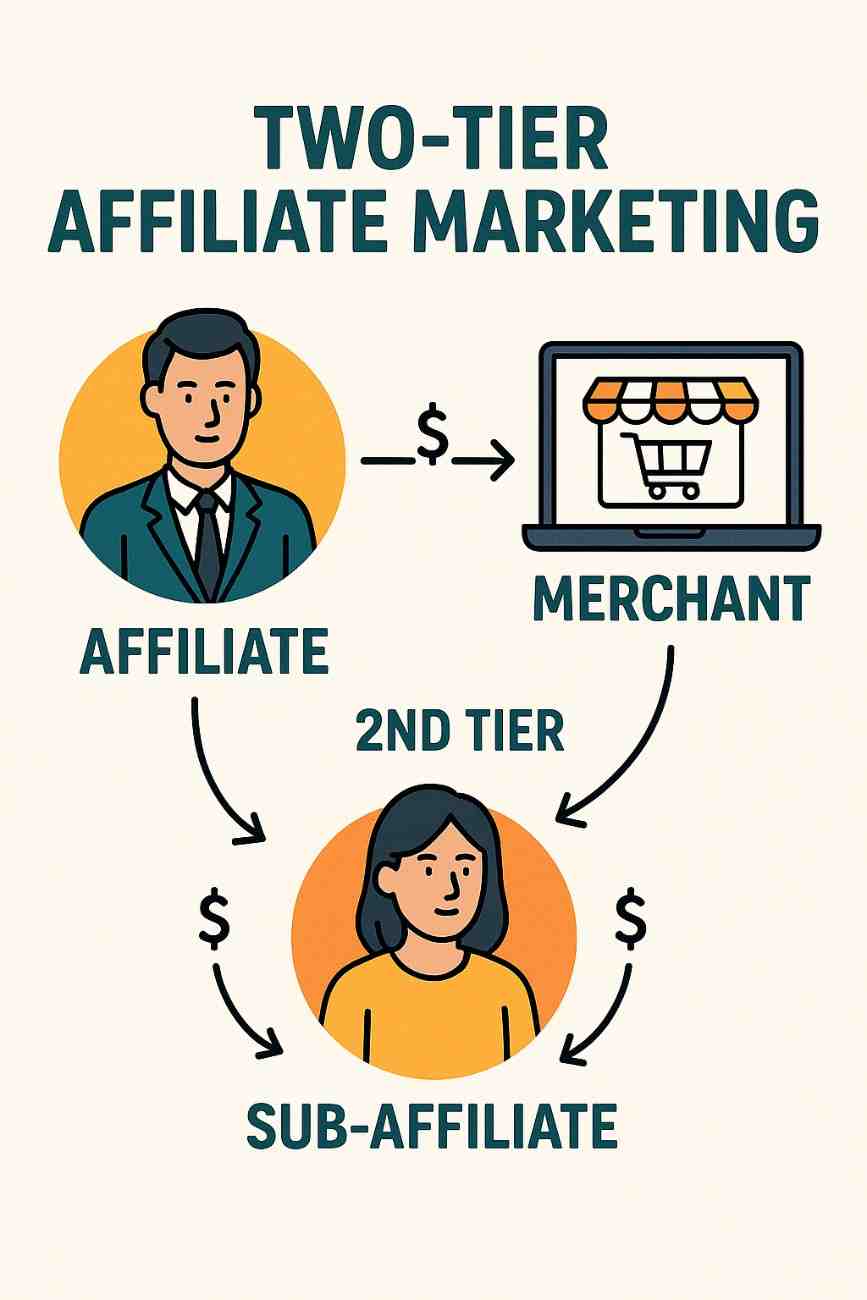
Affiliate marketing has evolved significantly over the past few decades, becoming a foundational component of digital advertising and e-commerce growth. While traditional affiliate marketing focuses on promoting products and earning commissions for direct referrals, more complex and rewarding structures have emerged over time. One such structure is two-tier affiliate marketing, a model that extends the scope of earning by allowing affiliates to recruit other affiliates and earn a commission on their performance as well.
In this comprehensive explanation, we will define two-tier affiliate marketing, explain how it works, describe its benefits, discuss its challenges, and illustrate its use through practical examples. We will also compare it to traditional single-tier affiliate models to better understand its value for both affiliates and merchants.
1. What Is Two-Tier Affiliate Marketing?
Two-tier affiliate marketing is a form of affiliate marketing that allows affiliates not only to earn commissions for referring customers (as in the traditional model) but also to earn additional commissions for referring other affiliates who, in turn, generate sales or leads.
In simpler terms:
-
Tier 1: You refer a customer and earn a commission.
-
Tier 2: You refer another affiliate (often called a “sub-affiliate”), and you earn a percentage of their commissions or a fixed bonus whenever they refer customers.
This model is often compared to multi-level marketing (MLM), but it’s not the same. Two-tier affiliate marketing typically stops at the second level (two tiers only), whereas MLM can have unlimited levels or downlines.
2. How Does Two-Tier Affiliate Marketing Work?
Here’s how the process typically unfolds:
Step 1: Sign Up as an Affiliate
You join an affiliate program that offers two-tier commission structures. The program provides you with two types of links:
-
Product links to promote to customers
-
Referral links to invite other affiliates
Step 2: Promote the Product
You share your affiliate links through blogs, videos, social media, email newsletters, etc. If someone clicks your link and makes a purchase, you earn a commission — just like in standard affiliate marketing.
Step 3: Recruit Other Affiliates
You also promote the affiliate program itself, encouraging others to join. You share your referral link for the affiliate program with friends, bloggers, influencers, or marketers.
Step 4: Earn Tier-Two Commissions
Once your referred affiliate starts promoting the product and earns commissions, you receive a second-tier commission, typically a small percentage of their earnings or sales.
Example Structure of Commissions:
Let’s say:
-
Tier 1 commission: 30% per sale
-
Tier 2 commission: 10% of sub-affiliate’s earnings
If:
-
You directly sell a product worth ₹2,000 → You earn ₹600 (30%)
-
You recruit another affiliate who sells the same product → They earn ₹600 (30%), and you earn ₹60 (10%) from their sale.
Over time, if your referred affiliates perform well, your passive earnings from Tier 2 can become substantial — even if you’re not actively making sales yourself.
3. Real-World Example:
Company: ConvertKit (Email Marketing Tool)
ConvertKit, an email marketing software for creators, offers a two-tier affiliate program.
-
Tier 1 commission: 30% recurring for life on direct referrals
-
Tier 2 commission: 5% recurring commission on referred affiliates’ earnings
Scenario:
Ravi is a digital marketer who signs up for ConvertKit’s affiliate program. He promotes ConvertKit on his blog and earns recurring income each time someone signs up and pays for the service.
Ravi also refers his friend Neha, a YouTuber, to become a ConvertKit affiliate. Neha starts promoting ConvertKit and earns ₹10,000 per month in affiliate commissions.
Thanks to the two-tier system, Ravi earns ₹500 (5% of ₹10,000) every month — without any extra effort beyond recruiting Neha.
If Ravi refers 10 such affiliates who each earn ₹10,000/month, he earns ₹5,000/month passively from Tier 2 alone.
4. Benefits of Two-Tier Affiliate Marketing
✅ a. Passive Income
The biggest benefit of two-tier affiliate marketing is the opportunity to earn passive income. Once you recruit productive affiliates, you earn from their success indefinitely — even if you take a break from active promotion.
✅ b. Encourages Affiliate Growth
Two-tier models incentivize affiliates to build teams. This creates a network of motivated affiliates, increasing the reach of the merchant’s product through exponential growth.
✅ c. Higher Earning Potential
Unlike traditional models that rely solely on individual performance, two-tier systems reward you for team-building and network expansion. This opens the door to much higher earnings over time.
✅ d. Mutual Support Among Affiliates
Senior affiliates (top-level) are motivated to mentor and support their sub-affiliates, since their earnings are tied to their success. This creates a more engaged and educational affiliate community.
✅ e. Reduced Merchant Workload
Merchants benefit by acquiring affiliates at scale without direct recruitment. Existing affiliates act as recruiters, helping the business grow organically with minimal effort from the company.
✅ f. Viral Potential
The referral aspect gives the program a viral effect, especially when affiliate marketers actively encourage their audiences to join the program as sub-affiliates.
5. Challenges of Two-Tier Affiliate Marketing
While the model is attractive, it does come with some potential issues:
❌ a. Complexity
Managing two levels of commission payouts, tracking, and reporting requires advanced affiliate software. Without the right systems, things can get disorganized.
❌ b. Commission Dilution
Some merchants may offer lower Tier 1 commissions to offset the cost of Tier 2 payouts, making it slightly less lucrative for solo affiliates.
❌ c. Risk of Abuse
There’s a risk that some people will focus on recruiting affiliates only and not promoting the actual product — leading to reduced product visibility and potential spam.
❌ d. Not Widely Available
Not all affiliate programs offer two-tier structures. Most affiliate programs are single-tier, so affiliates have fewer options when looking for programs with this structure.
6. Who Should Use Two-Tier Affiliate Marketing?
✅ Ideal for Affiliates Who:
-
Have an audience of marketers or creators who could also become affiliates
-
Want to diversify income streams beyond direct product promotion
-
Are comfortable building networks and offering mentorship or guidance
✅ Ideal for Businesses Who:
-
Want to scale quickly with limited budget
-
Believe in peer-driven promotion
-
Can manage the technical complexity of tiered commission systems
7. Tools and Platforms That Support Two-Tier Affiliate Models
Several platforms make it easier to set up and manage two-tier affiliate programs:
-
Post Affiliate Pro
-
Tapfiliate
-
FirstPromoter
-
LeadDyno
-
ReferralCandy (for eCommerce)
These tools allow for:
-
Tracking multiple tiers of referrals
-
Managing custom commission rates
-
Providing reporting dashboards for both tiers
-
Ensuring secure and timely payouts
8. Difference Between Single-Tier and Two-Tier Affiliate Marketing
| Feature | Single-Tier Affiliate Marketing | Two-Tier Affiliate Marketing |
|---|---|---|
| Commission Source | From personal referrals only | From personal referrals and sub-affiliates |
| Recruitment Earnings | No earnings for referring other affiliates | Earn a percentage of sub-affiliates’ activity |
| Earning Potential | Limited to direct sales | Higher potential via network-building |
| Complexity | Simple to manage | Requires advanced tracking and software |
| Ideal For | Product-focused marketers | Team-building marketers |
9. Conclusion
Two-tier affiliate marketing is a powerful model that adds a new layer of opportunity for those in the affiliate marketing space. It allows affiliates not only to earn commissions on their direct promotional efforts but also to build a team of sub-affiliates whose performance contributes to their passive income. This dual earning strategy transforms affiliate marketing from a transactional model into a scalable and sustainable income stream.
For businesses, two-tier programs create a viral network effect, expanding reach without the need for large marketing budgets. For affiliates, it’s an opportunity to leverage influence and mentorship to create recurring revenue.
While it requires more organization and ethical management than single-tier systems, the rewards — both financially and professionally — can be far greater. With the right tools, a focused strategy, and a willingness to support others, two-tier affiliate marketing can be a game-changer for anyone looking to grow in the digital economy.
Example in Summary:
If you’re a blogger who signs up for a two-tier affiliate program and refer 10 affiliates — each making ₹10,000/month in commissions — you could be earning ₹1,000 from each (10%), totaling ₹10,000/month in passive income, even if you make no direct sales yourself. That’s the true power of two-tier affiliate marketing.

