
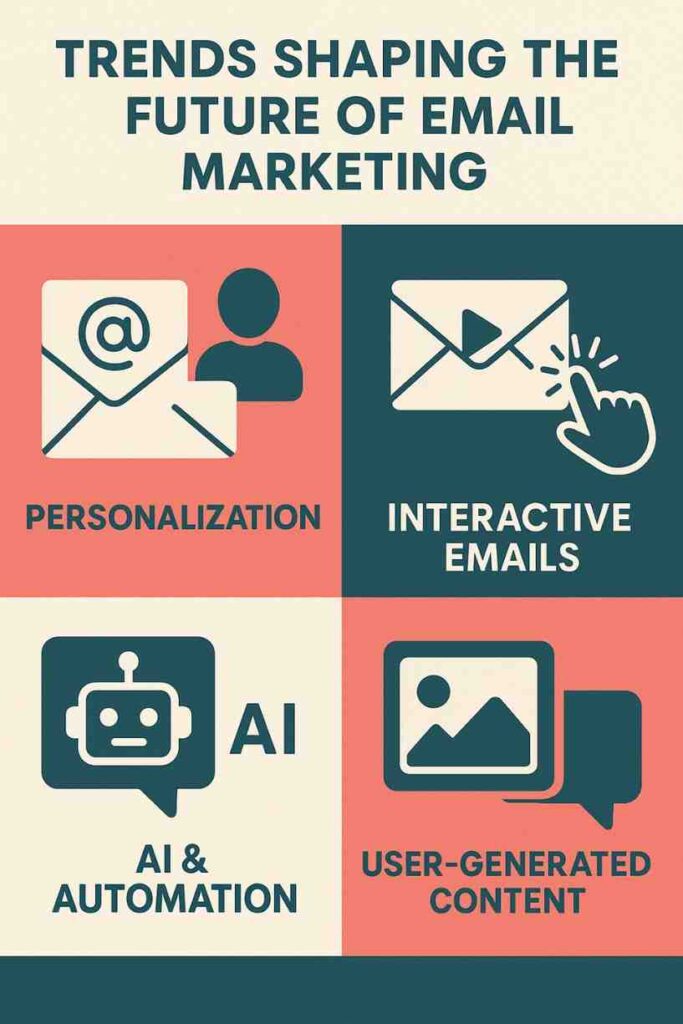
Email marketing remains one of the most cost-effective and powerful digital marketing tools available. Despite the rise of social media, messaging apps, and AI-driven communication tools, email continues to offer high return on investment (ROI), direct access to customers, and unmatched personalization capabilities. However, the landscape of email marketing is continuously evolving.
With changes in technology, consumer behavior, data privacy regulations, and digital infrastructure, marketers must adapt to remain effective. This article explores in detail the key trends shaping the future of email marketing, why these trends matter, how businesses can embrace them, and includes a real-world example to demonstrate their application.
1. Hyper-Personalization Through AI and Data
One of the most significant shifts in email marketing is the move from simple segmentation to hyper-personalization. Traditional email campaigns group subscribers into broad segments (e.g., location, gender, age). But today’s consumers expect messages tailored to their individual behavior, preferences, and engagement history.
How This Works:
-
AI analyzes customer data such as:
-
Browsing behavior
-
Purchase history
-
Time spent on site
-
Email open rates and click patterns
-
-
Based on this data, emails are personalized with:
-
Product recommendations
-
Dynamic content blocks
-
Personalized subject lines and send times
-
Why It Matters:
According to studies, personalized emails deliver 6x higher transaction rates and 29% higher open rates than non-personalized ones.
Future Outlook:
AI tools like predictive analytics and machine learning will drive deeper personalization. Marketers will use real-time data to tailor emails on the fly, even moments before the recipient opens the message.
2. Automation and Behavioral Triggers
Automation has moved beyond sending welcome emails or birthday offers. The future of email marketing lies in trigger-based automation, where emails are sent based on real-time actions and behaviors.
Examples of Behavioral Triggers:
-
Abandoned cart emails
-
Post-purchase follow-ups
-
Subscription renewal reminders
-
Inactivity or engagement-based emails
-
Browsing history triggers (e.g., “You looked at this item…”)
Benefits:
-
Timely and relevant communication
-
Increased conversion rates
-
Reduced manual work for marketers
-
Higher user engagement
Future Outlook:
With AI integrations, future automation systems will be able to predict user actions and trigger emails proactively—before the user even knows they need something.
3. Interactive Emails (AMP for Email)
One of the more exciting email trends is the rise of interactive content within emails. Powered by AMP for Email (Accelerated Mobile Pages), marketers can now embed interactive features such as:
-
Carousels
-
Forms and polls
-
Shopping carts
-
Live survey results
-
Event RSVPs
-
Appointment booking
Why This Matters:
Instead of clicking out to a website, users can engage directly within the email, improving user experience and reducing drop-off.
Future Outlook:
Expect more brands to use interactive elements to keep recipients engaged and increase actions taken directly from the inbox.
4. Privacy-First Marketing and Data Regulations
The future of email marketing must align with stricter privacy regulations worldwide. Laws such as:
-
GDPR (European Union)
-
CCPA (California)
-
CASL (Canada)
-
DPDP Act (India’s upcoming data protection law)
These require marketers to:
-
Obtain clear, informed consent
-
Let users control their data
-
Offer easy opt-out options
-
Avoid data misuse or third-party sharing without permission
Trend Implications:
-
Double opt-in will become standard practice
-
Transparent data use policies will gain importance
-
Permission-based marketing will dominate
Future Outlook:
Marketers will rely more on zero-party data (information users voluntarily give) and first-party data (behavior observed on owned channels) to reduce dependency on third-party data.
5. Mobile Optimization and Responsive Design
With over 60% of emails opened on mobile devices, mobile optimization is no longer optional.
Key Practices:
-
Use responsive email templates
-
Short subject lines and concise content
-
Large buttons and clear calls-to-action
-
Test across multiple devices and email clients
Emerging Trends:
-
Dark mode optimization: Emails designed to display properly in dark mode
-
Voice-assist friendly content: Emails that can be easily read by screen readers or voice assistants
Future Outlook:
The future may see email designs that are not just mobile-optimized but voice-searchable and wearable-device friendly.
6. User-Generated Content (UGC) in Emails
Marketers are incorporating user-generated content into email campaigns to build trust and authenticity. This includes:
-
Customer reviews
-
Photos from social media (e.g., tagged brand images)
-
Testimonials
-
Case studies
Why It Works:
UGC builds social proof, increases engagement, and encourages community participation.
Future Outlook:
With API integrations and AI-based moderation tools, marketers will be able to pull in live, curated UGC into automated email workflows.
7. AI-Generated Content and Subject Line Optimization
AI is being used not just for analysis but also for content creation. Tools like ChatGPT, Jasper, and Copy.ai can generate:
-
Subject lines
-
Product descriptions
-
Email body copy
-
Personalized greetings and sign-offs
AI also performs A/B testing on:
-
Subject lines
-
Send times
-
Content structure
Benefits:
-
Faster campaign execution
-
Better-performing content
-
Data-driven content decisions
Future Outlook:
In the future, AI will be able to predict the best message for each individual on a contact list and send tailored versions in real-time.
8. Email and Omnichannel Integration
Email marketing is no longer isolated. It’s becoming part of a broader omnichannel strategy where data from social media, apps, websites, and customer service interactions informs email communication.
Examples:
-
A customer browses a product on a mobile app and later receives a personalized email offer.
-
Customer service chat leads to an automated email follow-up.
-
A social media engagement triggers an email with related content.
Future Outlook:
CRM tools will integrate more seamlessly across platforms, allowing businesses to create unified customer journeys where email acts as the backbone.
9. Focus on Deliverability and Engagement Metrics
With email filters and algorithms becoming smarter, deliverability depends on engagement metrics, not just list size or frequency.
Key Engagement Metrics:
-
Open rate
-
Click-through rate (CTR)
-
Bounce rate
-
Spam complaints
-
Unsubscribe rate
Best Practices:
-
Clean email lists regularly
-
Re-engage inactive subscribers
-
Use preference centers to let users customize frequency/content
Future Outlook:
Marketers will increasingly use AI-powered tools to track engagement in real time and adjust campaigns accordingly for optimal deliverability.
10. Sustainability and Minimalism in Email Design
As digital sustainability gains attention, email marketers are embracing minimalist design, faster-loading content, and low-data usage formats.
Practices Include:
-
Avoiding image-heavy designs
-
Using lightweight code
-
Designing with accessibility in mind
Future Outlook:
Sustainable and inclusive email design will become a brand expectation rather than a nice-to-have.
Real-World Example: Trend Application in Action
Company: Nike
Objective: Launch a new line of sustainable running shoes
Email Campaign Elements Using Future Trends:
-
Hyper-Personalization:
-
Data from Nike app tracks user fitness preferences.
-
Email shows personalized recommendations based on user’s past purchases and running habits.
-
-
Automation & Triggers:
-
Users who viewed the product but didn’t purchase receive an abandoned browse email within 24 hours.
-
Those who added to cart but didn’t buy get a limited-time offer.
-
-
Interactive Content:
-
Embedded product carousel in email allows scrolling through the shoe collection without visiting the site.
-
Users can select shoe size and color within the email.
-
-
Privacy Compliance:
-
Double opt-in for email subscription.
-
Link to detailed privacy policy and user data rights.
-
-
Mobile Optimization:
-
Responsive design for different screen sizes.
-
Optimized images and CTA buttons for mobile touch.
-
-
UGC Integration:
-
Social proof included with real customer reviews and photos.
-
Hashtag campaign to encourage community participation.
-
-
AI-Powered Subject Line:
-
Split-tested subject line: “Built for the Run. Designed for the Planet.” vs “The Future of Running Starts Here.”
-
-
Omnichannel Connection:
-
Users engaging with the email are retargeted on social media platforms with consistent branding.
-
Results:
-
40% increase in email open rate
-
25% improvement in click-through rate
-
Significant increase in app downloads due to seamless cross-channel connection
Conclusion
The future of email marketing is being shaped by a convergence of technology, consumer expectations, data privacy regulations, and evolving digital habits. From AI-driven personalization and automation to interactive content and mobile optimization, the landscape is transforming rapidly.
For businesses, adapting to these trends isn’t just about keeping up—it’s about staying relevant in a competitive market where attention is fleeting and trust is earned. Email marketers who embrace these trends will be better positioned to create engaging, compliant, and value-driven campaigns that resonate with modern consumers.
As email marketing continues to evolve, one principle remains constant: respect your audience, deliver value, and communicate with purpose. The brands that remember this will not only survive but thrive in the ever-changing digital world.