
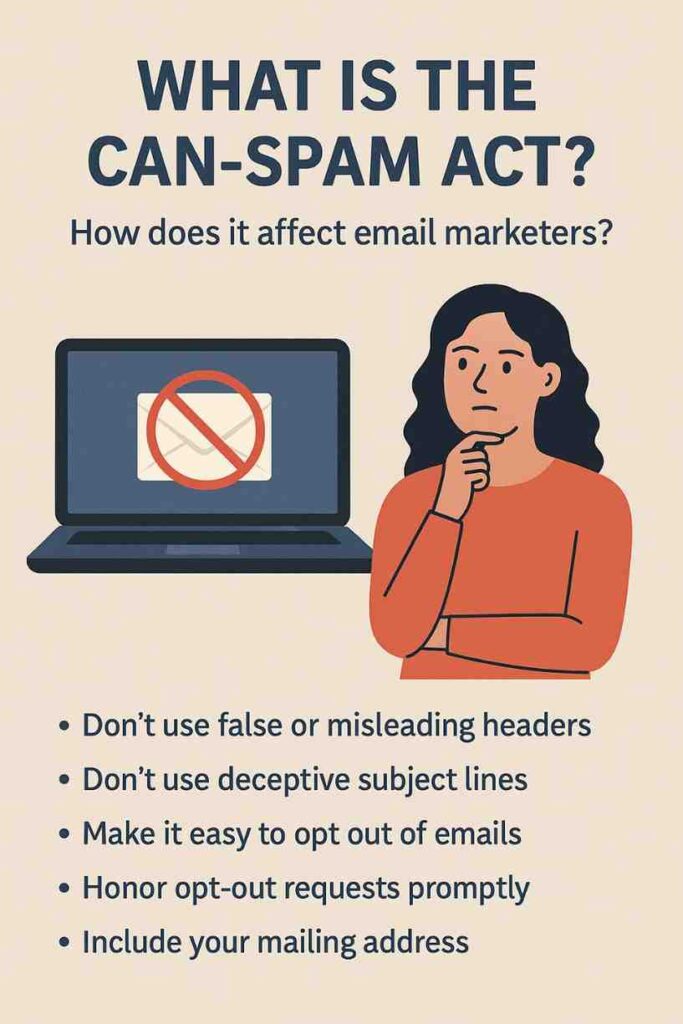
The CAN-SPAM Act (Controlling the Assault of Non-Solicited Pornography and Marketing Act) is a U.S. federal law enacted in 2003 to regulate commercial email communications and combat spam. As of 2025, it remains a cornerstone of email marketing compliance, setting standards for transparency, consent, and user control in email campaigns. For email marketers, understanding and adhering to the CAN-SPAM Act is critical to avoid hefty fines, maintain sender reputation, and build trust with audiences. This article provides a comprehensive explanation of the CAN-SPAM Act, its key requirements, its impact on email marketers, enforcement mechanisms, and best practices for compliance. It concludes with a practical example illustrating how a small business ensures compliance while running an email campaign.
What is the CAN-SPAM Act?
The CAN-SPAM Act is a U.S. law designed to protect consumers from unsolicited commercial emails while establishing clear guidelines for businesses sending marketing messages. Signed into law on December 16, 2003, it applies to all commercial emails—defined as messages whose primary purpose is to advertise or promote a product, service, or business opportunity. The law aims to reduce spam, enhance transparency, and give recipients control over their inboxes.
Scope of the CAN-SPAM Act
- Applicability: Applies to any commercial email sent to U.S. recipients, regardless of where the sender is located.
- Exemptions: Does not cover transactional or relationship emails (e.g., order confirmations, account updates), unless they include commercial content.
- Enforcement: Overseen by the Federal Trade Commission (FTC), with additional authority granted to the Federal Communications Commission (FCC), state attorneys general, and internet service providers (ISPs).
Key Requirements of the CAN-SPAM Act
The CAN-SPAM Act outlines seven primary requirements for commercial emails:
- Don’t Use False or Misleading Header Information:
- The email’s “From,” “To,” “Reply-To,” and routing information (including domain and email address) must be accurate and identify the sender.
- Example: Using a “From” name like “Your Bank” when the sender is a third-party marketer is prohibited.
- Don’t Use Deceptive Subject Lines:
- Subject lines must reflect the email’s content and not mislead recipients about the purpose or offer.
- Example: A subject line like “You Won a Free Vacation!” for an email promoting a timeshare purchase violates this rule.
- Identify the Message as an Advertisement:
- If the email is commercial, it must clearly indicate its promotional nature, though no specific wording is required.
- Example: Including a note like “This is a promotional message” in the email footer ensures transparency.
- Provide a Valid Physical Postal Address:
- The email must include the sender’s physical mailing address, which can be a street address, a registered post office box, or a commercial mail receiving agency.
- Example: A footer with “123 Main St, Suite 100, Anytown, USA” meets this requirement.
- Offer a Clear Opt-Out Mechanism:
- Recipients must be given a way to unsubscribe from future commercial emails, such as a link or reply option.
- The opt-out process must be free, easy, and functional for at least 30 days after the email is sent.
- Example: An unsubscribe link at the bottom of the email that instantly removes the recipient from the list complies with this rule.
- Honor Opt-Out Requests Promptly:
- Senders must process unsubscribe requests within 10 business days and cannot send further commercial emails to opted-out recipients.
- Example: Failing to remove a user from the mailing list after they unsubscribe within 10 days violates the law.
- Monitor Third-Party Compliance:
- Businesses are responsible for ensuring that third-party marketers (e.g., agencies, affiliates) hired to send emails on their behalf comply with the CAN-SPAM Act.
- Example: A company hiring a marketing firm must verify that the firm uses accurate headers and provides opt-out options.
Additional Considerations
- Mobile Messaging: The FCC extends CAN-SPAM rules to commercial text messages, requiring prior consent and opt-out options.
- Penalties: Violations can result in fines of up to $51,744 per email (as of 2025, adjusted for inflation), with potential criminal penalties for egregious offenses (e.g., using harvested email addresses).
- Preemption: The CAN-SPAM Act preempts most state anti-spam laws, but some state laws (e.g., California’s) impose stricter requirements.
How the CAN-SPAM Act Affects Email Marketers
The CAN-SPAM Act significantly shapes email marketing practices by enforcing transparency, accountability, and respect for recipient preferences. Below are the key ways it impacts email marketers in 2025:
1. Ensuring Transparency and Trust
The requirement for accurate headers, truthful subject lines, and clear identification of promotional content forces marketers to prioritize transparency. This builds trust with recipients, which is critical in an era where consumers are wary of spam and phishing.
- Impact: Marketers must craft honest subject lines and sender names that align with their brand, avoiding clickbait tactics that could trigger complaints or spam filters.
- Example: Instead of “Free iPhone Giveaway!” for a promotional email, marketers use “Explore Our New Smartphone Deals!” to accurately reflect the content.
2. Mandating Opt-Out Mechanisms
The opt-out requirement ensures recipients have control over their inboxes, reducing spam complaints and maintaining list health.
- Impact:
- Marketers must include functional unsubscribe links in every commercial email, even for transactional messages with promotional content.
- They must invest in email platforms (e.g., Brevo, Mailchimp) that automate opt-out processing within 10 days.
- High unsubscribe rates may signal irrelevant content, prompting marketers to refine segmentation or content strategies.
- Example: A marketer using Klaviyo ensures every campaign includes an unsubscribe link that instantly updates the contact’s status in the CRM.
3. Requiring Physical Address Inclusion
Including a postal address enhances accountability but can pose challenges for remote or small businesses.
- Impact:
- Marketers must secure a valid address, such as a P.O. box, and include it in email footers.
- This requirement may deter some businesses due to privacy concerns or logistical costs.
- Example: A freelancer uses a commercial mail receiving agency address to comply without exposing their home address.
4. Influencing List Acquisition and Consent
While the CAN-SPAM Act does not require explicit opt-in consent (unlike GDPR), it implicitly encourages permission-based marketing to minimize opt-outs and complaints.
- Impact:
- Marketers avoid purchasing email lists, as these often lead to high bounce rates, complaints, and violations (e.g., sending to harvested addresses).
- Double opt-in processes, though not mandatory, are adopted to ensure engaged subscribers and reduce spam traps.
- Email validation tools (e.g., NeverBounce) are used to maintain list health and comply with header accuracy rules.
- Example: A marketer implements double opt-in via HubSpot to confirm subscribers’ interest, reducing the risk of spam complaints.
5. Increasing Accountability for Third-Party Vendors
Marketers hiring agencies or affiliates must ensure compliance, adding a layer of oversight.
- Impact:
- Contracts with third parties must include CAN-SPAM compliance clauses.
- Marketers must audit vendor practices, such as header accuracy and opt-out functionality.
- Non-compliance by vendors can result in shared liability, prompting due diligence.
- Example: A retailer reviews its agency’s email templates to confirm they include a valid address and unsubscribe link.
6. Affecting Campaign Costs and Resources
Compliance requires investment in tools, processes, and training, impacting budgets.
- Impact:
- Small businesses may face costs for email platforms, validation tools, or legal reviews.
- Staff training on CAN-SPAM rules is necessary to avoid accidental violations.
- Non-compliance fines ($51,744 per email) pose a significant financial risk, especially for high-volume campaigns.
- Example: A startup allocates $500 monthly for Brevo and ZeroBounce to ensure compliance and list health.
7. Shaping Sender Reputation and Deliverability
Compliance with CAN-SPAM enhances sender reputation, which ISPs use to determine inbox placement.
- Impact:
- Low complaint rates (<0.1%) and bounce rates (<2%) signal a compliant sender, improving deliverability (80–90% inbox placement).
- Violations (e.g., misleading headers) can lead to blacklisting by anti-spam organizations like Spamhaus, blocking emails.
- Example: A compliant marketer maintains a 1% bounce rate, ensuring emails reach Gmail inboxes instead of spam folders.
8. Encouraging Global Compliance Awareness
While CAN-SPAM is U.S.-specific, it prompts marketers to consider stricter international laws like GDPR (EU) or CASL (Canada).
- Impact:
- Marketers targeting global audiences adopt stricter standards (e.g., explicit consent) to comply with multiple regulations.
- Tools like CRMs (e.g., ActiveCampaign) help manage consent across jurisdictions.
- Example: A U.S. marketer targeting EU subscribers implements GDPR-compliant opt-in forms to align with both CAN-SPAM and GDPR.
Enforcement and Penalties
The FTC is the primary enforcer of the CAN-SPAM Act, with authority to investigate violations and impose fines. ISPs, state attorneys general, and the FCC (for mobile messages) can also pursue legal action.
- Fines: Up to $51,744 per non-compliant email, with no cap on total penalties.
- Criminal Penalties: Apply to severe violations, such as using harvested lists or spoofing headers, with up to 7 years in prison.
- Examples of Enforcement:
- In 2023, a company paid $1.2 million for sending emails with misleading subject lines and no opt-out options.
- ISPs like Google have blocked non-compliant senders, citing CAN-SPAM violations.
Best Practices for Email Marketers in 2025
- Use Transparent Headers and Subject Lines: Ensure “From” names reflect the brand and subject lines match content.
- Implement Easy Opt-Outs: Include visible unsubscribe links in every email, processed within 10 days.
- Include a Physical Address: Add a valid postal address in email footers, even for small businesses.
- Adopt Permission-Based Marketing: Use double opt-in and avoid purchased lists to reduce complaints.
- Validate Email Lists: Use tools like EmailListVerify to remove invalid addresses and maintain deliverability.
- Monitor Third-Party Vendors: Audit agencies or affiliates for compliance.
- Leverage Email Platforms: Use tools like Mailchimp or Brevo with built-in CAN-SPAM compliance features.
- Train Staff: Educate teams on CAN-SPAM rules to prevent accidental violations.
- Track Metrics: Monitor complaint rates, bounce rates, and unsubscribes to assess compliance and list health.
- Stay Global-Minded: Align with stricter laws like GDPR for international campaigns.
Example: CAN-SPAM Compliance for a Small Ecommerce Business
Scenario: “GreenGlow,” a small ecommerce business selling eco-friendly skincare products, uses Klaviyo to send email campaigns to 3,000 subscribers. They aim to promote a new product line while ensuring CAN-SPAM compliance to avoid penalties and maintain deliverability.
Implementation:
- Transparent Headers and Subject Lines:
- GreenGlow sets the “From” name as “GreenGlow Skincare” with the email address hello@greenglow.com.
- They craft subject lines like “Discover Our New Eco-Friendly Moisturizer!” to accurately reflect the email’s promotional content, avoiding misleading phrases like “Free Product Inside!”
- Advertisement Identification:
- Each email includes a footer note: “This is a promotional email from GreenGlow Skincare,” ensuring transparency.
- Physical Address:
- GreenGlow includes their office address in the footer: “GreenGlow, 456 Eco Lane, Suite 200, Portland, OR 97201.”
- They verify the address is registered and valid with the U.S. Postal Service.
- Opt-Out Mechanism:
- Klaviyo automatically adds an unsubscribe link to every email, labeled “Unsubscribe from our emails.”
- The link directs to a preference center where users can opt out instantly or adjust email frequency.
- GreenGlow tests the link to ensure it remains functional for 30 days post-send.
- Prompt Opt-Out Processing:
- Klaviyo’s CRM updates contact statuses in real-time, ensuring opted-out users are removed from lists within 24 hours (well within the 10-day requirement).
- GreenGlow monitors opt-out requests weekly to confirm compliance.
- List Acquisition and Validation:
- GreenGlow uses double opt-in for website signups, requiring users to confirm subscriptions via a confirmation email.
- They integrate Klaviyo with NeverBounce to validate emails, removing 200 invalid addresses (e.g., user@nonexistent.com), reducing bounce rates to 1%.
- Third-Party Oversight:
- GreenGlow hires a marketing agency to design email templates but includes a CAN-SPAM compliance clause in the contract.
- They review templates to ensure accurate headers, opt-out links, and address inclusion.
- Campaign Execution:
- GreenGlow launches a 3-email series promoting their new moisturizer:
- Email 1: Introduces the product with a “Shop Now” CTA.
- Email 2: Shares customer testimonials and a 10% discount code.
- Email 3: Reminds users of the discount’s expiration.
- Each email complies with CAN-SPAM, with clear headers, subject lines, and opt-out options.
- GreenGlow launches a 3-email series promoting their new moisturizer:
- Analytics and Compliance Monitoring:
- Metrics (after 1 month):
- Open Rate: 28% (industry average: 20–30%).
- CTR: 6% (industry average: 3–5%).
- Conversion Rate: 3% (90 sales, $4,500 revenue).
- Bounce Rate: 1%.
- Complaint Rate: 0.05% (<0.1% threshold).
- Unsubscribe Rate: 0.4% (<0.5% ideal).
- GreenGlow’s low complaint and bounce rates confirm compliance, ensuring 95% inbox placement.
- They adjust Email 3’s subject line (“Last Chance: 10% Off Ends Tonight!”) to boost opens to 30%.
- Metrics (after 1 month):
Results:
- The campaign drives $4,500 in revenue, exceeding the goal of $3,000.
- Compliance avoids fines and maintains sender reputation, with no spam folder issues.
- Double opt-in and validation ensure a healthy list, supporting future campaigns.
- Oversight of the agency prevents third-party violations.
Key Takeaways:
- Klaviyo’s compliance features simplified adherence to CAN-SPAM.
- Transparent headers, opt-outs, and validation enhanced trust and deliverability.
- Monitoring metrics ensured ongoing compliance and campaign success.
Conclusion
The CAN-SPAM Act of 2003 remains a critical framework for email marketers in 2025, enforcing transparency, recipient control, and accountability in commercial email campaigns. Its requirements—accurate headers, truthful subject lines, opt-out mechanisms, and physical addresses—shape how marketers design, send, and manage emails, impacting costs, deliverability, and audience trust. While compliance requires investment in tools and processes, it protects against severe penalties ($51,744 per email) and enhances sender reputation. The GreenGlow example demonstrates how a small business can leverage platforms like Klaviyo to comply with CAN-SPAM, drive revenue, and maintain list health. By adopting best practices like double opt-in, validation, and third-party oversight, email marketers can navigate the CAN-SPAM Act effectively, ensuring successful, compliant campaigns in a competitive digital landscape.