
Introduction
In the world of digital communication, particularly email marketing, the term “deliverability” plays a critical role. While sending emails to subscribers, customers, or prospects might seem straightforward, the reality is much more complex. Simply pressing the “send” button doesn’t guarantee that the intended recipient will actually see the email in their inbox. This is where deliverability comes into play.
Deliverability refers to the success rate at which your emails reach your recipients’ inboxes, rather than getting filtered into spam folders or being rejected entirely. It determines the effectiveness of your email marketing campaigns, affects your sender reputation, and influences how well your messages connect with your audience.
In this comprehensive guide, we will explore:
-
What deliverability is and how it differs from delivery rate
-
Why it matters for email marketers and businesses
-
The key factors that influence deliverability
-
Practical strategies to improve it
-
A real-world example to illustrate best practices
What is Email Deliverability?
Deliverability, often referred to as email deliverability, is the percentage of emails that actually land in the inbox of recipients, as opposed to being filtered into spam, rejected by the email server, or lost in transmission.
It is often confused with email delivery, which merely refers to whether the email was accepted by the recipient’s mail server. Deliverability takes it one step further — it measures whether the email appeared in the primary inbox and was accessible and visible to the user.
For example:
-
If you send 1,000 emails and 990 are accepted by recipient servers, your delivery rate is 99%.
-
But if only 600 go to inboxes, and the rest go to spam, your deliverability rate is 60%.
This distinction is critical. High delivery doesn’t mean high visibility or engagement — which is ultimately what marketers aim for.
Why Deliverability Matters
Deliverability is crucial because:
-
Inbox placement impacts open and click rates. If emails land in spam folders, they are less likely to be seen or engaged with.
-
Poor deliverability damages sender reputation, making future campaigns even less effective.
-
Revenue is directly tied to visibility. Especially for eCommerce, SaaS, affiliate marketers, and content creators, emails that aren’t seen translate into lost opportunities.
-
Regulatory compliance (GDPR, CAN-SPAM) requires clean and permission-based email marketing. Ignoring deliverability can lead to legal issues.
In short, deliverability affects every step of your email marketing funnel — from message visibility to conversion rates and return on investment (ROI).
Factors That Affect Deliverability
Deliverability depends on a complex interplay of technical, behavioral, and content-based factors. Below are some of the most influential:
1. Sender Reputation
Internet Service Providers (ISPs) assign a sender score or reputation to your IP address and domain. If you have a high complaint rate, send to invalid addresses, or spam your users, your reputation drops.
Key issues that affect reputation:
-
High bounce rates
-
Spam complaints
-
Blacklisting by anti-spam organizations
-
Low engagement (opens, clicks)
2. Email Authentication
ISPs verify that you are a trusted sender using email authentication protocols:
-
SPF (Sender Policy Framework): Validates the sender’s IP address.
-
DKIM (DomainKeys Identified Mail): Verifies that the email content hasn’t been altered.
-
DMARC (Domain-based Message Authentication, Reporting & Conformance): Instructs ISPs on how to handle unauthorized messages.
Lack of authentication is one of the top reasons for poor deliverability.
3. List Hygiene
Maintaining a clean email list is vital. This means:
-
Removing hard bounces (invalid emails)
-
Unsubscribing inactive users
-
Segmenting users based on behavior
Continuing to email unengaged users can lead to higher spam complaints and ISP filtering.
4. Content Quality
Email content that looks spammy can trigger filters. Consider:
-
Using too many exclamation marks (!!!)
-
All-caps subject lines
-
Misleading subject lines
-
Too many images and not enough text
-
No unsubscribe link
Filters use advanced AI to analyze your message. Even certain phrases (e.g., “Get Rich Quick”) can flag your content.
5. Engagement Metrics
ISPs like Gmail or Yahoo observe how users interact with your emails:
-
Do users open them?
-
Do they reply?
-
Do they move them from spam to inbox?
Higher engagement rates tell ISPs that your emails are wanted, which improves future deliverability.
6. Sending Behavior
How and when you send emails affects your reputation. Sudden volume spikes, sending too many emails at once, or emailing large lists from new IPs/domains can lead to blocks.
Best practices include:
-
Warm-up schedules for new domains
-
Consistent sending patterns
-
Avoiding spam traps
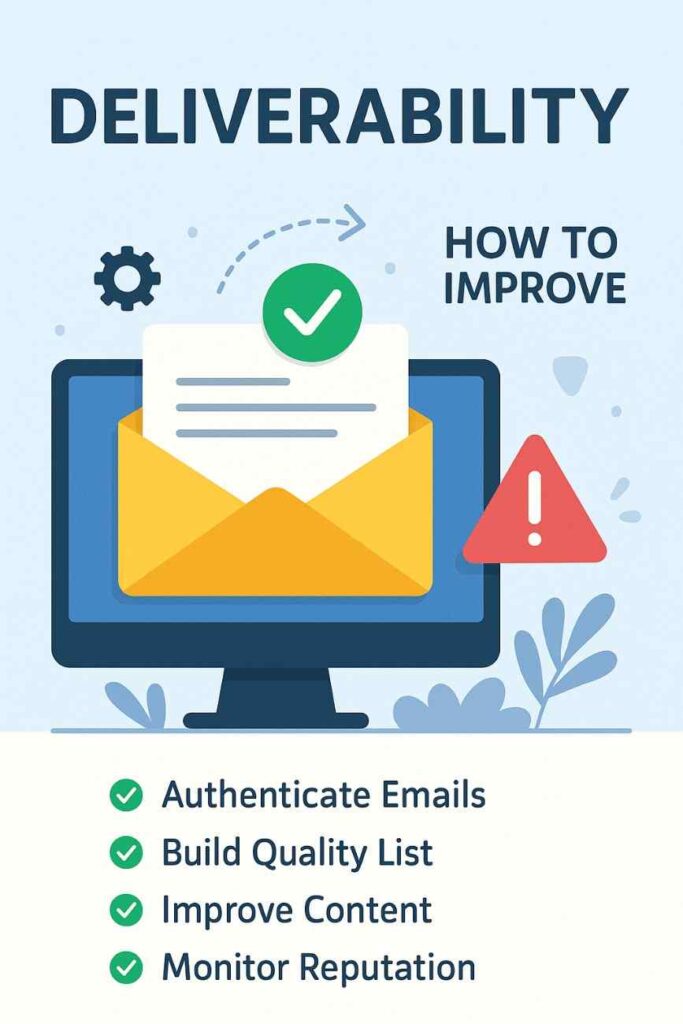
How to Improve Email Deliverability
Now that we’ve covered what affects deliverability, let’s look at actionable steps to improve it.
1. Use a Reputable Email Marketing Platform
Platforms like Mailchimp, ConvertKit, Sendinblue, or ActiveCampaign have built-in features to manage deliverability. They handle authentication, maintain IP reputation, and provide bounce handling systems.
2. Authenticate Your Emails
Set up:
-
SPF and DKIM records on your domain
-
A DMARC policy to reduce spoofing
This ensures ISPs can trust your emails.
3. Maintain List Hygiene
-
Use double opt-in to validate subscribers
-
Remove users who haven’t engaged in 3–6 months
-
Use list cleaning tools (e.g., NeverBounce, ZeroBounce)
-
Segment users based on activity levels
4. Optimize Content for Deliverability
-
Avoid spam-trigger words like “Free Money,” “Act Now,” “Click Here!”
-
Keep a good text-to-image ratio (avoid image-only emails)
-
Use mobile-responsive templates
-
Always include an unsubscribe link
-
Avoid attachments in mass emails
5. Monitor Engagement
-
Track open, click, and bounce rates
-
Test subject lines with A/B testing
-
Re-engage inactive users with win-back campaigns
-
Stop emailing completely inactive users
6. Warm Up New Domains and IPs
If you’ve just created a new domain, don’t start with 10,000 emails. Instead:
-
Send small batches (e.g., 100 emails per day)
-
Gradually increase volume over weeks
-
Monitor reputation and engagement closely
This process, known as “warming up,” signals to ISPs that you’re a legitimate sender.
7. Avoid Purchased Lists
One of the worst deliverability practices is sending emails to purchased, scraped, or third-party lists. These are often filled with:
-
Inactive or outdated emails
-
Spam traps
-
People who never opted in
Sending to such lists leads to instant reputation damage.
8. Regularly Test and Monitor
Use tools like:
-
Mail-Tester.com: Checks spam score and authentication.
-
Postmark, SendForensics, or GlockApps: Analyze deliverability metrics.
-
Google Postmaster Tools: See how Gmail users interact with your emails.
Continuous testing ensures you’re adapting to evolving spam filters and ISP behaviors.
Example: An eCommerce Brand Improving Deliverability
Let’s consider the example of EcoWear, a small eCommerce brand selling sustainable clothing online. Initially, their email campaigns had:
-
A 25% open rate
-
A 4% click-through rate
-
A high bounce rate of 8%
-
Many emails landing in spam folders
Steps EcoWear took to improve deliverability:
-
Authentication Setup:
They worked with their email service provider to set up SPF, DKIM, and DMARC on their domain. -
List Cleanup:
They removed unengaged users and verified emails using a cleaning service. -
Segmentation:
They created separate lists for active, dormant, and VIP customers, and tailored emails accordingly. -
Content Overhaul:
They revamped email templates to include less aggressive language, added plain-text alternatives, and ensured clear branding and CTA. -
Warm-up Strategy:
When switching to a new ESP, they gradually increased send volumes and tracked engagement closely. -
Engagement Campaigns:
They ran a win-back campaign titled “We Miss You — Here’s 20% Off” targeting inactive users. -
Monitoring:
They used Postmark to track deliverability and inbox placement, and used Google Postmaster Tools for sender reputation.
Results after 3 months:
-
Open rate improved to 42%
-
Click-through rate reached 9%
-
Bounce rate dropped to 0.7%
-
Spam complaints reduced significantly
The improved deliverability directly led to a 23% increase in sales from email marketing, showing the real business impact of good practices.
Conclusion
Deliverability is more than a technical concept — it’s the backbone of successful email marketing. When your emails don’t land in the inbox, you lose visibility, engagement, and revenue. By understanding the factors that influence deliverability and implementing best practices — from authentication and list hygiene to content quality and engagement tracking — businesses and creators can ensure their messages reach the right audience at the right time.
Improving deliverability is not a one-time task but an ongoing process. As spam filters evolve and user behavior changes, marketers must remain vigilant, ethical, and data-driven. The difference between an email being seen or ignored can mean the success or failure of an entire campaign.
In a world where competition for inbox space is fierce, deliverability is your ticket to attention, trust, and results.