
Introduction
Email marketing remains one of the most powerful and cost-effective digital marketing strategies available to businesses today. While social media and SEO strategies grab headlines, email marketing continues to deliver a high return on investment (ROI), with studies showing an average ROI of $42 for every $1 spent. One of the most effective systems within this domain is the email funnel — a structured and strategic approach to converting leads into customers through a series of targeted emails.
In this detailed guide, we will explore what an email funnel is, how it functions at each stage of the customer journey, and how businesses can implement one effectively. We’ll also provide an appropriate real-world example to show how an email funnel works in practice.
What is an Email Funnel?
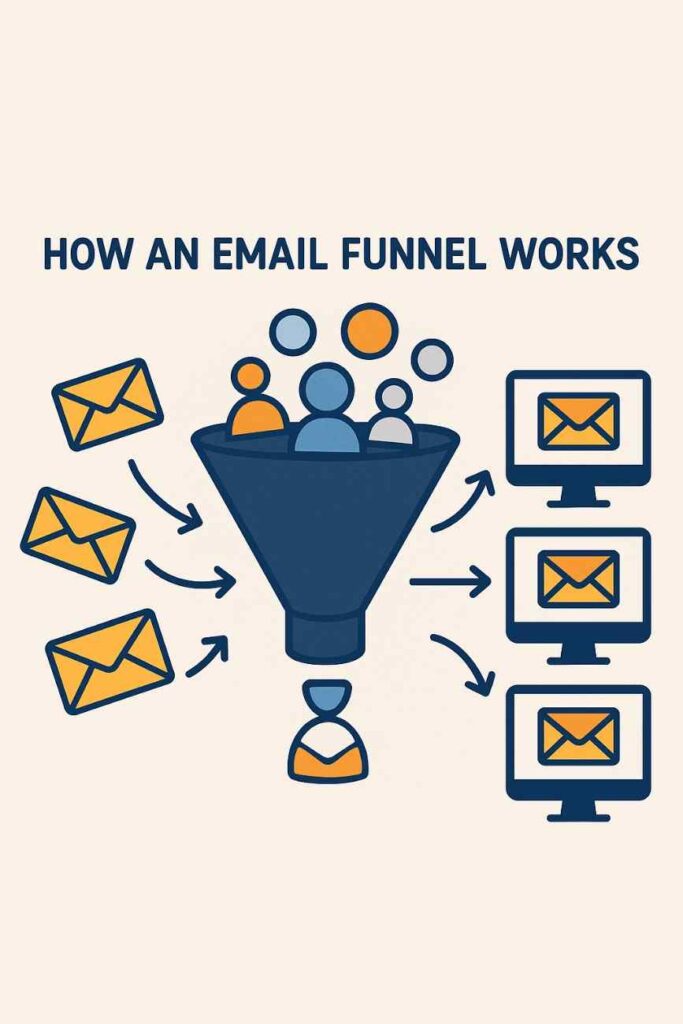
An email funnel, also known as an email marketing funnel, is a systematic sequence of automated emails designed to guide a potential customer through the buyer’s journey — from awareness to decision and ultimately to action (purchase or conversion). The funnel metaphor is used because many people enter the top of the funnel (awareness), but only a smaller portion makes it through to the bottom (conversion).
The primary goal of an email funnel is to nurture leads, build trust, and educate potential customers so they are more likely to take the desired action, whether it’s making a purchase, signing up for a service, downloading a resource, or attending a webinar.
Why Email Funnels Are Important
Email funnels are essential because:
-
They automate the buyer’s journey. Instead of sending random or one-off emails, funnels automate a personalized path for each user.
-
They build trust over time. You don’t ask someone to buy immediately — you nurture the relationship gradually.
-
They save time and resources. After setting up the funnel, it can run indefinitely with little manual input.
-
They provide measurable results. Each stage can be tracked and optimized.
-
They align with user intent. People receive different messages depending on where they are in the customer journey.
Stages of an Email Funnel
An email funnel generally follows the stages of the traditional marketing funnel. These stages are:
1. Awareness Stage (Top of the Funnel – TOFU)
Objective: Introduce your brand or solution to the subscriber.
At this stage, people may have signed up for a newsletter, downloaded a freebie, or filled out a lead form. They’re not ready to buy yet. The focus here is on providing value and establishing credibility.
Types of Emails:
-
Welcome emails
-
Brand introduction
-
Educational content (blogs, guides)
-
Free downloads (eBooks, templates)
-
Problem-identifying content
Key Features:
-
No hard selling
-
Strong storytelling
-
Clear branding
-
Helpful resources
2. Consideration Stage (Middle of the Funnel – MOFU)
Objective: Nurture the lead by solving specific pain points and offering solutions.
Now that the lead is familiar with your brand, the next step is to provide more targeted content that shows how your product or service can help them. This is where you can start gently introducing your offerings.
Types of Emails:
-
Product guides or feature explanations
-
Case studies or testimonials
-
FAQs or industry comparisons
-
Webinar or demo invitations
Key Features:
-
Educational with a hint of sales intent
-
Showcasing value and benefits
-
Increasing user engagement
3. Decision Stage (Bottom of the Funnel – BOFU)
Objective: Convert the lead into a customer.
This is where the recipient is ready to buy or take action. At this stage, emails should include strong calls-to-action (CTAs), compelling offers, and limited-time deals to encourage immediate conversions.
Types of Emails:
-
Discount or promo codes
-
Product trials
-
Consultations or demos
-
Testimonials and success stories
-
Scarcity-driven messages (“only 2 left!”)
Key Features:
-
Urgency and exclusivity
-
Clear next steps
-
Persuasive CTAs
4. Post-Purchase Stage (Retention and Advocacy)
Objective: Build loyalty and turn customers into repeat buyers or brand advocates.
The funnel doesn’t end after a purchase. Retention emails are essential for customer satisfaction, referrals, upsells, and long-term revenue.
Types of Emails:
-
Thank-you and confirmation emails
-
How-to guides for product use
-
Feedback requests
-
Referral programs
-
Upsell/cross-sell emails
-
Loyalty program invitations
Key Features:
-
Personal touches
-
Opportunities for engagement
-
Customer-first mindset
Automation and Tools
Modern email funnels are powered by email marketing automation platforms that allow businesses to trigger emails based on user actions and behavior. Common tools include:
-
Mailchimp
-
ConvertKit
-
Klaviyo
-
ActiveCampaign
-
HubSpot
-
GetResponse
Trigger examples:
-
A user signs up for a newsletter → triggers a welcome sequence.
-
A user clicks on a product link → triggers a product information email.
-
A user abandons their cart → triggers a reminder with a discount.
These tools let marketers create workflow maps (also called drip campaigns), ensuring timely delivery and consistent messaging.
Real-World Example: The Email Funnel of a Fitness Coaching Business
Let’s walk through a real-world example to understand how an email funnel functions.
Business: FitLife Coaching
Product: 12-week online personal training program
Stage 1: Awareness
A user lands on FitLife’s website via a blog post titled “5 Easy Workouts for Beginners.” There, they are invited to download a free PDF guide titled “Home Workout Plan for Busy People” in exchange for their email.
Email 1: Welcome Email
-
Thank you for downloading
-
Brief intro to the brand and founder
-
Link to follow social media accounts
Email 2: Educational Email
-
“Top 5 Mistakes Beginners Make While Working Out”
-
Includes link to another blog
Email 3: Personal Story
-
The founder shares a transformation story
-
Ends with “Want to know how we help people like this? Stay tuned.”
Stage 2: Consideration
Email 4: Free Video Series Invitation
-
“Want to get started today? Watch our 3-part video series.”
Email 5: Case Study
-
“How Sarah Lost 10 kg in 12 Weeks with Our Program”
Email 6: Program Introduction
-
Detailed explanation of the 12-week coaching program
-
No hard CTA yet — just awareness
Stage 3: Decision
Email 7: Early-Bird Offer
-
“Get 20% off if you enroll in the next 3 days”
-
Strong CTA: “Reserve Your Spot Now”
Email 8: Testimonials
-
Video reviews from past clients
Email 9: Final Reminder
-
“Offer ends tonight — don’t miss your chance!”
Stage 4: Post-Purchase
Email 10: Thank You Email
-
Welcome to the program
-
What to expect next
-
Access to onboarding materials
Email 11: Weekly Motivation
-
Fitness tips and encouragement every Monday
Email 12: Referral Program
-
“Refer a friend, get 1 free coaching session!”
Email 13: Upsell
-
“Interested in 1-on-1 Nutrition Coaching?”
Results:
-
Lead-to-customer conversion rate: 12%
-
Revenue from funnel: ₹3,00,000 in the first 2 months
-
Increase in social media engagement by 20%
-
High customer retention through post-purchase emails
Best Practices for Creating Effective Email Funnels
-
Define Your Goal: Are you nurturing leads, increasing sales, or launching a product?
-
Segment Your List: Send tailored content to different audience groups.
-
Write for Value: Focus on solving problems, not just selling.
-
Use Strong CTAs: Each email should guide the user to the next logical step.
-
Test and Optimize: A/B test subject lines, content, and send times.
-
Personalize: Use names, locations, and behaviors to make emails feel personal.
-
Ensure Mobile Optimization: More than 60% of users open emails on their phones.
Conclusion
An email funnel is much more than a series of emails — it’s a strategic communication journey designed to build trust, educate, nurture, and convert leads into loyal customers. From awareness to decision and beyond, email funnels can automate relationships and increase revenue without constant manual effort.
Using powerful tools and segmentation, marketers can tailor each email to resonate with the recipient’s needs and behaviors. By aligning with the buyer’s journey, delivering the right message at the right time, and optimizing each stage, businesses can turn cold leads into hot sales.
Whether you run an eCommerce store, offer digital products, or provide services, an effective email funnel is one of the smartest investments you can make in your marketing strategy. It’s your silent salesman — working day and night to grow your business.