
Affiliate marketing has grown into one of the most powerful and flexible ways to generate revenue online. Whether you’re a business looking to promote your products or an individual seeking passive income opportunities, affiliate marketing offers a performance-based solution where marketers (affiliates) earn a commission for referring traffic, leads, or sales to a merchant (advertiser).
But affiliate marketing is not a one-size-fits-all model. In fact, it has evolved into several types of models, each with its own structure, goals, and payment system. Understanding the major types of affiliate marketing models is crucial for both advertisers and affiliates in choosing the right strategy that aligns with their business objectives and marketing style.
In this essay, we will explore in detail the major types of affiliate marketing models, their structures, how they work, their benefits and limitations, and provide real-world examples to make each type more understandable.
1. Pay-Per-Sale (PPS)
Definition:
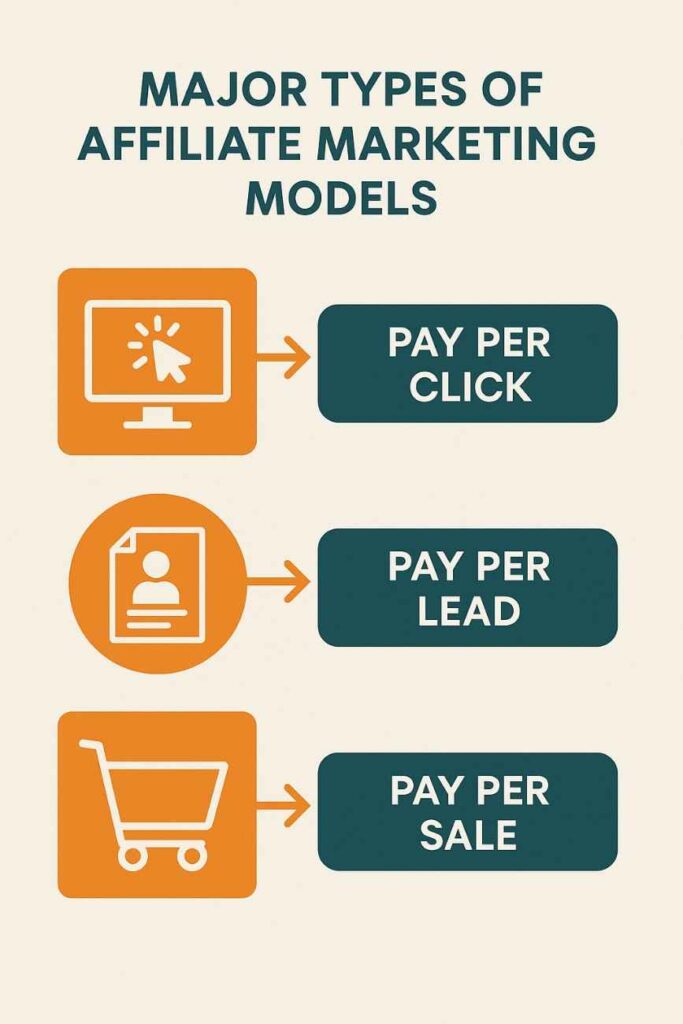
Pay-per-sale is the most common and straightforward affiliate marketing model. In this model, affiliates earn a commission when the customer they refer makes an actual purchase.
How It Works:
-
The affiliate promotes a product using a unique affiliate link.
-
A consumer clicks the link and buys the product.
-
The affiliate receives a percentage of the sale (commonly 5%–50%, depending on the product).
Advantages:
-
Low risk for advertisers: they only pay for successful sales.
-
High earning potential for affiliates, especially with high-ticket items.
Disadvantages:
-
No earnings unless a sale is made.
-
It may take time to convert visitors into buyers.
Example:
An affiliate writes a blog post reviewing various fitness trackers. They include affiliate links to Amazon. When a reader clicks the link and buys a Fitbit worth ₹10,000, the affiliate earns a 6% commission, i.e., ₹600.
2. Pay-Per-Click (PPC)
Definition:
In the pay-per-click model, affiliates earn money whenever a user clicks on the advertiser’s link, regardless of whether a purchase is made.
How It Works:
-
The affiliate embeds an ad or link in their content.
-
A visitor clicks the link and is taken to the advertiser’s website.
-
The affiliate gets paid per click (usually a few cents to a few rupees).
Advantages:
-
Low barrier to entry for affiliates; clicks are easier to get than sales.
-
Immediate earnings, even if users don’t buy anything.
Disadvantages:
-
High risk for advertisers: they pay even if the clicks don’t convert.
-
Affiliates may focus on quantity over quality, leading to low conversion rates.
Example:
A tech blogger places banner ads for a mobile phone brand. For each click from their blog to the advertiser’s website, they earn ₹2. If 1,000 people click the ad, they earn ₹2,000, even if no purchases are made.
3. Pay-Per-Lead (PPL)
Definition:
The pay-per-lead model rewards affiliates for directing visitors who perform a specific action, such as filling out a form, signing up for a newsletter, or registering for a free trial.
How It Works:
-
The affiliate shares a link to a landing page with a form or signup.
-
A visitor clicks the link and completes the desired action.
-
The affiliate gets paid a fixed amount per lead.
Advantages:
-
Easier than PPS as no purchase is needed.
-
Useful for services or products with a long sales cycle.
Disadvantages:
-
Leads may not convert into actual customers.
-
Can be subject to fraud (fake sign-ups or bots).
Example:
A finance blog refers users to a credit card comparison website. Every time a user signs up for a free credit score report, the affiliate earns ₹100. If 50 users sign up, they earn ₹5,000.
4. Two-Tier Affiliate Marketing
Definition:
Two-tier affiliate marketing allows affiliates to not only earn commissions for referring customers but also for referring new affiliates to the program.
How It Works:
-
An affiliate refers another affiliate to the merchant’s program.
-
When the second-tier affiliate makes a sale, the first affiliate earns a small percentage (often 5%–10%) in addition to their own commissions.
Advantages:
-
Encourages affiliates to grow a team or network.
-
Creates long-term income opportunities.
Disadvantages:
-
Requires a strong network-building ability.
-
Often lower commission on the second tier.
Example:
An affiliate marketer joins a software affiliate program and refers another marketer to join as well. The second affiliate sells ₹50,000 worth of software in a month. The referring affiliate earns 10%, i.e., ₹5,000 as a second-tier commission.
5. Cost Per Install (CPI)
Definition:
This model is common for mobile app and software promotions. Affiliates get paid every time someone installs an app through their referral link.
How It Works:
-
The affiliate promotes a mobile app or desktop software.
-
A user installs the app via the affiliate’s link.
-
The affiliate receives a payment, usually between ₹10–₹100 per install.
Advantages:
-
Easy to convert since users don’t have to pay anything.
-
Great for startups and app developers looking for quick growth.
Disadvantages:
-
Lower payouts compared to sales-based models.
-
Risk of fake installs and fraud.
Example:
An affiliate promotes a new language-learning app. For every install via their link, they earn ₹25. If 1,000 users install the app, they earn ₹25,000.
6. Cost Per Action (CPA)
Definition:
CPA is a broad model where affiliates are paid for a wide variety of predefined actions — not just sales, leads, or installs. This can include watching a video, subscribing to a channel, or completing a survey.
How It Works:
-
The affiliate promotes a campaign with a specific action goal.
-
The user performs the action.
-
The affiliate earns a fixed fee for each action completed.
Advantages:
-
Diverse opportunities for monetization.
-
High conversion rates for simple actions.
Disadvantages:
-
May require careful audience targeting to be profitable.
-
Some actions are low-paying.
Example:
A YouTuber promotes a platform offering ₹50 for each person who watches a 3-minute promotional video. If 500 people watch the full video, the affiliate earns ₹25,000.
7. Revenue Sharing
Definition:
Revenue sharing is a model where the affiliate earns a percentage of the customer’s payments — not just a one-time sale, but possibly recurring payments over time.
How It Works:
-
The affiliate refers a customer.
-
The customer subscribes or makes recurring purchases.
-
The affiliate gets a share of the revenue for as long as the customer stays active.
Advantages:
-
Long-term earning potential.
-
Encourages affiliates to refer high-quality, loyal customers.
Disadvantages:
-
Requires consistent engagement and promotion.
-
Only profitable if customers remain subscribed.
Example:
An affiliate promotes a digital marketing tool with a subscription fee of ₹2,000/month. The affiliate earns 20% monthly commission (₹400/month) per customer. If 50 customers subscribe and remain active for 6 months, the affiliate earns ₹400 × 50 × 6 = ₹1,20,000.
8. Influencer/Ambassador Affiliate Model
Definition:
In this hybrid model, influencers act as brand ambassadors and promote products through content, often with personalized promo codes.
How It Works:
-
The influencer receives a unique coupon code or affiliate link.
-
They promote the product on Instagram, YouTube, etc.
-
Followers use the code or link to buy the product, and the influencer earns a commission.
Advantages:
-
Builds brand trust.
-
Works well with loyal and engaged audiences.
Disadvantages:
-
Success depends heavily on the influencer’s reputation.
-
Commissions may be smaller due to one-time discounts.
Example:
A beauty influencer with 100k followers shares a 15% off coupon for a skincare brand. For each sale through the code, she earns 10% of the sale amount.
Conclusion
Affiliate marketing encompasses a wide variety of models, each tailored to different business goals and audience behaviors. Here’s a summary of the major affiliate marketing models:
| Model | Commission Trigger | Ideal For |
|---|---|---|
| Pay-Per-Sale (PPS) | Customer makes a purchase | Product-based businesses |
| Pay-Per-Click (PPC) | Visitor clicks on an ad or link | Blogs with high traffic |
| Pay-Per-Lead (PPL) | User signs up or completes a form | Service providers |
| Two-Tier | Referral of other affiliates or sub-affiliates | Network marketers |
| Cost-Per-Install | App/software installation | Mobile app developers |
| Cost-Per-Action | User completes any action (watch, survey, etc.) | Marketers with broad engagement goals |
| Revenue Sharing | Customer makes recurring payments | SaaS, subscription-based businesses |
| Influencer Model | Code usage or tracked promotion via content | Social media influencers |
The flexibility of affiliate marketing means there’s a model suitable for nearly every niche, platform, and business objective. Choosing the right one depends on your resources, your audience, and your long-term vision. For advertisers, understanding these models allows for better partnerships and optimized ROI. For affiliates, picking the right model opens doors to sustainable and scalable income streams in the digital economy.