
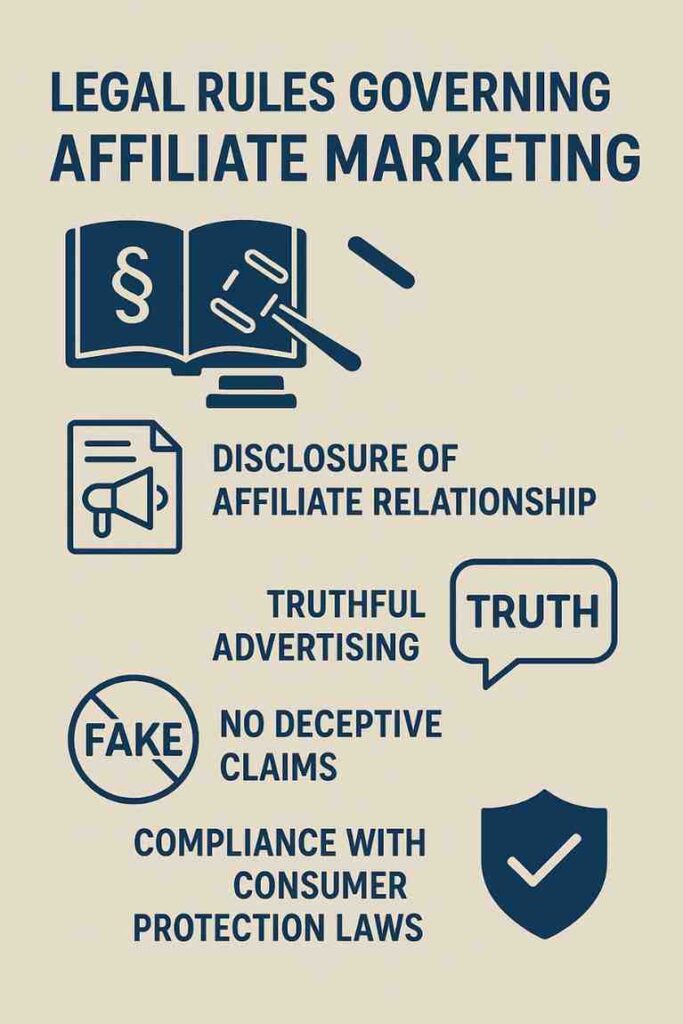
Affiliate marketing is a booming digital marketing strategy where individuals (affiliates) earn commissions by promoting a company’s products or services. While it offers significant income potential and business growth opportunities, affiliate marketing is also subject to legal regulations. These rules aim to ensure fairness, transparency, and protection for consumers, advertisers, and affiliates. Failure to comply with these laws can lead to penalties, fines, and even lawsuits.
This article explores the major legal rules governing affiliate marketing, covering regulations in the U.S. (especially from the Federal Trade Commission), Europe (such as the GDPR), and other global standards. We will also discuss best practices for compliance and conclude with a relevant example to show how these laws apply in real-life scenarios.
1. Federal Trade Commission (FTC) Guidelines – United States
The Federal Trade Commission (FTC) in the United States is one of the main regulatory bodies overseeing affiliate marketing practices. The FTC’s primary concern is consumer protection, especially in regard to advertising transparency and truth-in-advertising laws.
a. Disclosure of Affiliate Relationships
The FTC mandates that affiliates must clearly disclose their relationships with brands. In simple terms, if an affiliate receives a commission for promoting a product or service, the audience must be informed of this relationship clearly and conspicuously.
Key Rules:
-
The disclosure must be placed near the affiliate link, not buried in a footer or on a separate page.
-
It must be in plain, understandable language (e.g., “I earn commissions if you buy through this link.”).
-
Disclosures must be visible on all platforms – websites, blogs, social media posts, YouTube videos, etc.
Failing to disclose can lead to serious consequences, including legal actions against both the affiliate and the company they represent.
b. Truthful Advertising
Affiliates must not make false or misleading claims about a product or service. For instance:
-
You cannot say a product cures diseases if it doesn’t.
-
You must not exaggerate product benefits without proof.
-
Any claims made must be honest and substantiated by facts or personal experience.
2. General Data Protection Regulation (GDPR) – European Union
The GDPR is a strict data privacy regulation applicable to companies that collect or process personal data of individuals in the European Union (EU), regardless of where the company is based. Affiliate marketers must also follow GDPR when operating in or targeting EU users.
a. Data Collection Transparency
If an affiliate collects cookies to track referrals or user behavior (common in affiliate marketing), they must:
-
Get explicit consent from the user before placing tracking cookies.
-
Provide a privacy policy that clearly explains what data is collected and how it is used.
b. Right to Access and Erasure
Users have the right to:
-
Access their data collected via affiliate tracking.
-
Request deletion of their personal data.
Affiliates using email marketing or any user-based analytics must ensure they comply with GDPR’s data handling rules.
3. CAN-SPAM Act – United States
The CAN-SPAM Act applies to email marketing and is especially relevant to affiliates who use newsletters or promotional emails to share affiliate links.
Rules include:
-
Do not use misleading subject lines or headers.
-
Clearly identify the message as an advertisement.
-
Include a valid physical postal address.
-
Provide a working unsubscribe option.
-
Honor unsubscribe requests within 10 business days.
Violations of the CAN-SPAM Act can result in fines of up to $43,792 per email, making compliance critical.
4. Children’s Online Privacy Protection Act (COPPA)
If your affiliate marketing targets users under the age of 13, you must comply with COPPA. This law governs how websites and marketers collect data from children.
Requirements include:
-
Obtain verifiable parental consent before collecting any personal data.
-
Provide a clear privacy policy.
-
Ensure data is secure and confidential.
Most affiliates avoid marketing to children to steer clear of these strict regulations.
5. Platform-Specific Policies
In addition to government laws, many platforms have their own rules that affiliates must follow.
a. Amazon Associates Program
Amazon has a strict affiliate program with its own disclosure rules:
-
Affiliates must include a disclaimer such as:
“As an Amazon Associate, I earn from qualifying purchases.” -
They are not allowed to cloak or shorten links in a way that hides the Amazon domain.
-
Product reviews must be truthful and not incentivized.
Violating these terms can get an affiliate banned from the program.
b. Social Media Platforms
Each social media platform has unique rules regarding affiliate links:
-
Instagram and TikTok require the use of “#ad” or “#sponsored” hashtags.
-
YouTube’s community guidelines recommend verbal and written disclosures in videos.
-
Facebook Ads Manager may reject affiliate ads if they contain misleading content or unapproved landing pages.
6. International Legal Variations
Different countries have unique affiliate marketing laws. A few noteworthy examples:
-
Canada: Similar to the CAN-SPAM Act, Canada enforces CASL (Canadian Anti-Spam Legislation), which requires express consent before sending commercial electronic messages.
-
Australia: Under the Spam Act 2003, all marketing messages must include a way to unsubscribe and must not be deceptive.
-
India: While India lacks affiliate-specific laws, the Consumer Protection Act 2019 ensures that misleading ads and non-disclosures can be penalized.
Thus, affiliates working in multiple regions must research and comply with local regulations.
7. Contracts Between Affiliates and Merchants
Legal agreements or contracts are common in affiliate partnerships and typically cover:
-
Payment terms (e.g., per sale, per click).
-
Promotional guidelines.
-
Termination clauses.
-
Prohibited practices (like bidding on brand keywords or sending spam).
Affiliates must read the terms and conditions carefully before joining any program. Breaching contract terms could lead to termination or legal consequences.
8. Common Legal Mistakes in Affiliate Marketing
-
Hiding Disclosures: Using ambiguous language like “This is a partner link” without clarification.
-
No Cookie Consent: Especially on websites targeting European users.
-
Misrepresenting Earnings: Affiliates claiming “You can make $10,000 a week!” without proof.
-
Infringing Copyright: Using copyrighted logos, product images, or videos without permission.
-
Overpromising: Saying a supplement “cures diabetes” without FDA approval or scientific backing.
These practices can lead to warnings, bans, lawsuits, or penalties.
9. Best Practices for Legal Compliance
-
Always disclose affiliate relationships clearly.
-
Use GDPR-compliant plugins for cookie consent (e.g., CookieYes, Cookiebot).
-
Ensure email campaigns comply with CAN-SPAM or international equivalents.
-
Avoid clickbait headlines or false claims.
-
Keep records of all consents, transactions, and contracts.
-
Stay updated with changes in laws and platform policies.
10. Real-Life Example: Affiliate Compliance
Example: Affiliate Blogger “Sarah’s Home Finds”
Sarah runs a blog reviewing home décor products and uses Amazon affiliate links. She earns commissions through user purchases. To stay compliant:
-
She adds a disclosure at the top of every article:
“This post contains affiliate links. I may earn a commission if you make a purchase through my links, at no extra cost to you.” -
Sarah uses a cookie consent plugin for EU users and links to her Privacy Policy page explaining how cookies are used.
-
In her email newsletter, she includes:
-
A clear subject line (e.g., “Top Summer Decor Picks – Affiliate Deals Inside!”)
-
An unsubscribe link
-
Her full business address
-
-
She avoids false claims in her reviews, giving honest opinions and using images provided by the merchant or created by her.
Because of these practices, Sarah avoids legal troubles, builds trust with readers, and maintains a successful affiliate business.
Conclusion
Affiliate marketing is not just about earning passive income—it is also about following legal and ethical standards. With strict regulations from entities like the FTC, GDPR, and local governments, affiliates must take proactive steps to disclose relationships, protect user data, and provide truthful information.
Understanding and following these legal rules not only protects affiliates from penalties but also builds long-term trust with audiences and merchants. Whether you are a beginner or an experienced affiliate, compliance should be at the core of your marketing strategy.
By keeping up with legal requirements, using transparency in promotions, and respecting user rights, affiliate marketing can be both profitable and responsible.