
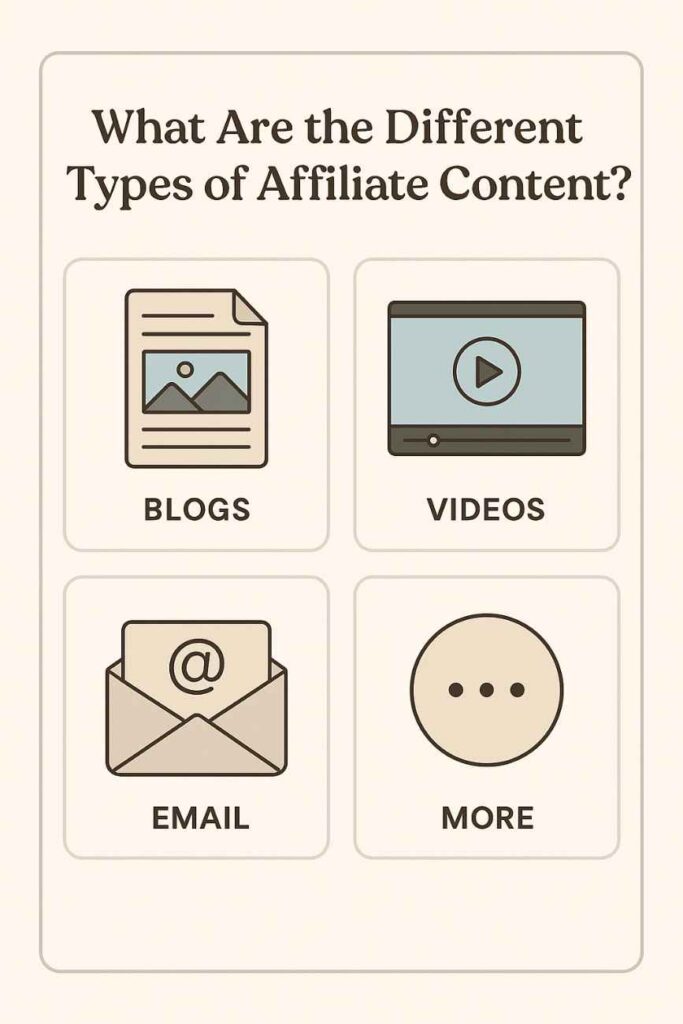
Affiliate marketing is a powerful way to earn income online by promoting products or services and earning a commission for every sale or lead generated through your referral link. But behind every successful affiliate marketer is a solid content strategy. Why? Because content is the vehicle through which affiliate promotions are delivered. Without engaging, valuable, and well-targeted content, affiliate links would have no audience, no engagement—and certainly no conversions.
Affiliate content is more than just inserting links into random posts. It’s about delivering the right message to the right audience at the right time—whether that’s through a blog post, a video, an email, or another medium.
In this detailed guide, we’ll explore the different types of affiliate content, how they work, their strengths and weaknesses, and when to use each format. We’ll also give a real-world example of how an affiliate marketer uses multiple content types together to maximize results.
Why Content Matters in Affiliate Marketing
Before diving into content types, let’s briefly understand why content is so important in affiliate marketing:
-
It builds trust and authority with your audience.
-
It educates the user about the benefits of the product.
-
It helps overcome objections or skepticism.
-
It aligns with user intent—whether someone is looking to learn, compare, or buy.
By matching your affiliate content to the user journey (awareness, consideration, decision), you can effectively guide your audience from interest to action—clicking and converting on your affiliate links.
The Main Types of Affiliate Content
Let’s now examine the most common types of affiliate content with their unique advantages and best-use cases:
1. Blog Posts and Articles
Overview
Blogging remains one of the most popular and effective affiliate marketing strategies. It offers flexibility, long-form depth, and the ability to rank for keywords in search engines (SEO).
Popular Blog Formats for Affiliate Marketing:
-
Product Reviews – Honest, in-depth evaluations of a single product.
-
Example: “Grammarly Premium Review 2025 – Is It Worth It?”
-
-
Comparison Posts – Comparing multiple products or services.
-
Example: “Bluehost vs SiteGround – Which Hosting Is Better for Beginners?”
-
-
Listicles – Lists of recommended tools or products.
-
Example: “Top 10 Budget Smartphones for Students in 2025”
-
-
How-To Guides and Tutorials – Educational content that integrates affiliate tools.
-
Example: “How to Start a Blog in 30 Minutes (Step-by-Step Guide)”
-
Benefits:
-
Good for SEO and long-term traffic.
-
Easy to insert contextual affiliate links.
-
Builds authority in your niche.
Challenges:
-
Requires consistent content creation.
-
SEO takes time and knowledge.
2. YouTube and Video Content
Overview
Video marketing is exploding in popularity, especially on platforms like YouTube, Instagram Reels, and TikTok. Video lets you show a product in action, building trust and engagement quickly.
Popular Video Formats:
-
Unboxings and First Impressions
-
Example: “Unboxing the DJI Osmo Pocket 3 – Best Vlogging Camera?”
-
-
Product Demonstrations
-
Example: “How to Use Canva to Design Instagram Posts (Beginner Tutorial)”
-
-
Side-by-Side Comparisons
-
Example: “Canva vs Adobe Express – Which Is Better for Creators?”
-
-
List Videos
-
Example: “Top 5 Budget Microphones for Podcasting in 2025”
-
You can place affiliate links in the video description, pinned comments, or within the video using pop-ups and annotations (where available).
Benefits:
-
High engagement and viewer retention.
-
Builds trust with a face or voice behind the content.
-
Videos can rank on both YouTube and Google.
Challenges:
-
Requires time, planning, and editing skills.
-
You need camera equipment and good lighting/audio.
-
Harder to update than written content.
3. Email Marketing
Overview
Email remains one of the most profitable digital marketing channels. With affiliate marketing, email helps you build a relationship with your audience and promote products in a personalized way.
Common Email Types for Affiliate Promotion:
-
Product Recommendations
-
Example: “Here’s the New Tool I’m Using to Organize My Workflow”
-
-
Exclusive Offers or Coupons
-
Example: “Get 40% Off Grammarly Premium This Week Only”
-
-
Email Sequences / Autoresponders
-
Example: A 5-day welcome series with a final pitch for an affiliate tool.
-
-
Content Roundups
-
Example: “Top 3 Blog Posts You May Have Missed (with affiliate links)”
-
Benefits:
-
You own your list—no algorithm involved.
-
High conversion rates due to trust and segmentation.
-
Perfect for repeat promotions and follow-ups.
Challenges:
-
You need to build your email list first.
-
Requires smart automation and timing to avoid sounding too salesy.
4. Social Media Content
Overview
Social media platforms like Instagram, Facebook, Pinterest, and TikTok are great for reaching new audiences and sharing short-form affiliate content.
Popular Content Ideas:
-
Product highlights in Stories or Reels
-
Behind-the-scenes content using the product
-
Mini reviews with direct purchase links
-
Shoppable posts or link-in-bio landing pages
Benefits:
-
Immediate reach and viral potential.
-
Perfect for visual or lifestyle-related products (beauty, fashion, fitness).
-
Easy to engage with comments and feedback.
Challenges:
-
Platforms often restrict direct affiliate links.
-
Fast-moving content—requires regular posting.
-
Not evergreen like blog posts or videos.
5. Ebooks and Lead Magnets
Overview
Free ebooks or checklists can be used to educate and capture leads while inserting affiliate links within the content.
Example:
-
“The Ultimate Guide to Remote Work in 2025” – includes tools for time management, VPNs, and ergonomic furniture, all with affiliate links.
Benefits:
-
Adds massive value in exchange for an email address.
-
Can be used as part of a funnel.
-
Offers long-term utility.
Challenges:
-
Time-consuming to create.
-
Requires traffic or a funnel to distribute.
6. Podcasts
Overview
Podcasts are growing fast. Hosts can recommend tools or products verbally and include affiliate links in show notes.
Example:
A finance podcaster talks about budgeting apps and promotes an affiliate deal with a tool like YNAB or Mint.
Benefits:
-
Highly loyal audiences.
-
Less competition in many niches.
-
Passive, multitask-friendly consumption.
Challenges:
-
Harder to track link clicks.
-
Setup can be technical.
-
Requires a regular publishing schedule.
Real-World Example: Using Multiple Content Types Together
Let’s take the example of James, an affiliate marketer in the productivity tools niche. He promotes Notion, an all-in-one workspace tool.
Here’s how James uses different content formats to grow his affiliate revenue:
-
Blog:
-
Writes an in-depth guide: “How I Use Notion to Organize My Life – 2025 Productivity Hack”
-
Includes affiliate links to Notion Pro.
-
-
YouTube:
-
Creates a video: “My Notion Setup for Weekly Planning – Full Walkthrough”
-
Drops the same affiliate link in the description.
-
-
Email:
-
Sends an email to his list: “My Top 3 Digital Tools for Focus (Includes Free Templates)”
-
Notion is #1, with the link included.
-
-
Instagram:
-
Posts a reel: “Before vs After Using Notion for Daily Routines”
-
Adds link in bio.
-
-
Free Ebook:
-
Offers a download: “7-Day Productivity Blueprint Using Notion”
-
The ebook includes affiliate links and bonus tools.
-
This multi-channel approach ensures James meets his audience wherever they are—reading, watching, or scrolling—and increases his chances of conversions.
Best Practices for Affiliate Content
-
Always disclose affiliate links clearly.
-
Prioritize value over promotion.
-
Match content format to audience behavior (e.g., Gen Z prefers short videos, professionals may prefer blogs).
-
Use data and analytics to track what’s working.
-
Repurpose content across platforms for efficiency.
Conclusion
Affiliate content is not one-size-fits-all. Different audiences, platforms, and products require different approaches. By understanding the strengths and limitations of various content types—blogs, videos, emails, social media, ebooks, and podcasts—you can build a diverse affiliate strategy that reaches more people and drives more sales.
No matter which format you choose, the golden rule is this: solve a problem, share a story, and offer value first. When you do that, your affiliate promotions will feel like helpful recommendations, not pushy sales pitches—and your earnings will reflect that.
Would you like help building a content calendar or writing your first affiliate blog or email? I’d be happy to assist with templates or content ideas tailored to your niche!