
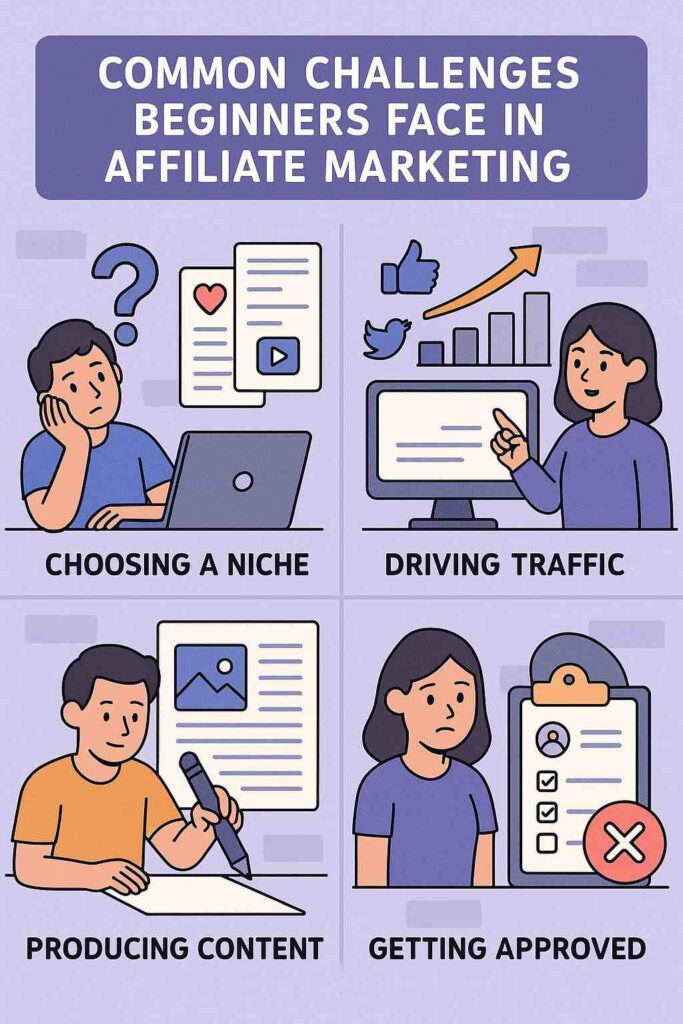
Affiliate marketing is an attractive opportunity for beginners to earn income online by promoting products or services and earning commissions for successful referrals. Its low entry barriers, minimal upfront costs, and potential for passive income make it appealing, especially for students, freelancers, or side hustlers. However, success in affiliate marketing is not guaranteed, and beginners often encounter significant challenges that can hinder progress. These obstacles stem from a lack of experience, unrealistic expectations, and the competitive nature of the industry. This essay explores the common challenges beginners face in affiliate marketing, detailing their causes, impacts, and strategies to overcome them, followed by a practical example to illustrate how a beginner can navigate these hurdles in 2025.
Common Challenges for Beginners in Affiliate Marketing
1. Lack of Knowledge and Experience
Description: Many beginners enter affiliate marketing without a clear understanding of its mechanics, such as how affiliate links work, commission structures, or promotional strategies. They may also lack skills in digital marketing disciplines like SEO, content creation, or paid advertising.
Causes:
- Limited access to structured training or reliance on outdated or misleading online resources.
- Overwhelm from the vast amount of information available on blogs, YouTube, or X posts.
- Misconceptions that affiliate marketing is a “get-rich-quick” scheme, leading to skipped learning.
Impact:
- Beginners may join unreliable programs or use ineffective strategies, wasting time and effort.
- Poor content quality or spammy tactics can damage credibility and lead to account bans.
- Lack of technical know-how (e.g., setting up a blog) delays progress.
Solutions:
- Invest time in learning from reputable sources like Authority Hacker, Income School, or X accounts like @AffiliateTips.
- Start with free resources (e.g., YouTube tutorials, Google’s SEO Starter Guide) and progress to affordable courses if needed.
- Experiment with one platform or niche to build skills gradually.
2. Choosing the Wrong Niche or Programs
Description: Selecting an unsuitable niche or affiliate program can derail success. Beginners may choose oversaturated niches (e.g., general fitness) or programs with low commissions or poor reliability.
Causes:
- Lack of market research, leading to niches with high competition or low demand.
- Attraction to broad, popular niches without considering personal interest or expertise.
- Joining programs with unfavorable terms (e.g., short cookie durations, high payout thresholds).
Impact:
- High competition makes ranking content or gaining traction difficult, reducing traffic and earnings.
- Low-commission programs (e.g., Amazon Associates at 1–4% for some categories) require high sales volumes to generate meaningful income.
- Unreliable programs may delay payments or shut down, causing financial loss.
Solutions:
- Use tools like Google Trends (free) or Ubersuggest (free) to identify niches with moderate demand and competition (e.g., “vegan fitness gear” vs. “fitness”).
- Research programs via X posts or reviews to ensure reliability and competitive commissions (e.g., SaaS programs with 20–50% recurring commissions).
- Align niches with personal interests to sustain motivation and authenticity.
3. Generating Consistent Traffic
Description: Driving traffic to affiliate content is a major hurdle, as beginners often lack the audience or skills to attract visitors via organic or paid channels.
Causes:
- Slow SEO results, with content taking 3–12 months to rank on Google.
- Limited understanding of social media algorithms or paid ad platforms.
- Inconsistent posting or failure to engage audiences on platforms like Instagram, X, or Pinterest.
Impact:
- Low traffic results in few affiliate link clicks, delaying earnings.
- Reliance on a single traffic source (e.g., social media) risks income loss from algorithm changes or bans.
- Paid ads can drain budgets without ROI if mismanaged.
Solutions:
- Focus on SEO with long-tail keywords (e.g., “best budget headphones for students 2025”) using Google Keyword Planner (free).
- Leverage free platforms like Pinterest or YouTube for evergreen traffic.
- Build an email list with Mailchimp (free for 500 subscribers) to nurture leads over time.
- Start with low-budget ads ($5/day) only after mastering organic traffic.
4. Creating High-Quality, Engaging Content
Description: Producing content that attracts, engages, and converts audiences is challenging for beginners, who may lack writing, design, or video production skills.
Causes:
- Limited experience in creating SEO-optimized or visually appealing content.
- Difficulty balancing value-driven content with promotional affiliate links.
- Time constraints, especially for students or those with full-time jobs.
Impact:
- Poor-quality content fails to rank, engage, or convert, reducing traffic and commissions.
- Overly salesy content erodes trust, lowering click-through rates.
- Inconsistent posting schedules hinder audience growth.
Solutions:
- Use Grammarly (free) for polished writing and Canva (free) for visuals like blog images or social posts.
- Follow templates from successful affiliates (e.g., product review structures: intro, features, pros/cons, CTA).
- Batch-create content using Trello (free) to schedule posts and maintain consistency.
5. Building Trust and Credibility
Description: Beginners struggle to establish authority and trust with audiences, especially in niches requiring expertise (e.g., finance, health) under Google’s E-E-A-T (Experience, Expertise, Authoritativeness, Trustworthiness) guidelines.
Causes:
- Lack of a personal brand or established online presence.
- Failure to disclose affiliate relationships, risking penalties or audience distrust.
- Promoting low-quality products to maximize short-term gains.
Impact:
- Low trust reduces conversions, as audiences hesitate to click affiliate links.
- Google penalizes content lacking E-E-A-T in YMYL (Your Money, Your Life) niches, lowering rankings.
- Negative feedback or bans from affiliate programs damage reputation.
Solutions:
- Include clear FTC-compliant disclosures (e.g., “This post contains affiliate links”).
- Share personal experiences or honest reviews to build authenticity (e.g., “I tested these headphones for a month”).
- Promote reputable products from trusted programs like ShareASale or CJ Affiliate.
6. Unrealistic Expectations and Lack of Patience
Description: Many beginners expect quick results, underestimating the time and effort required to earn significant income.
Causes:
- Hype from misleading online claims (e.g., “Earn $10,000/month in 30 days”).
- Lack of understanding that SEO, audience building, and conversions take months.
- Discouragement from initial low or no earnings.
Impact:
- Beginners may abandon efforts prematurely, missing long-term potential.
- Chasing quick wins leads to spammy tactics, risking bans or penalties.
- Frustration reduces motivation, hindering consistent effort.
Solutions:
- Set realistic goals (e.g., $100/month in 6 months) based on niche and effort.
- Track small wins (e.g., traffic growth, first sale) using affiliate dashboards or Google Analytics (free).
- Join communities on X or Reddit (e.g., r/AffiliateMarketing) for support and realistic insights.
7. Compliance and Program Restrictions
Description: Beginners often struggle with affiliate program rules, platform policies, or legal requirements, such as FTC disclosure guidelines.
Causes:
- Unfamiliarity with program terms (e.g., Amazon Associates prohibits direct ad links).
- Failure to disclose affiliate links, violating FTC or platform rules.
- Using restricted promotion methods (e.g., spamming forums).
Impact:
- Account suspensions or bans result in lost earnings and effort.
- Non-compliance damages credibility and risks legal issues.
- Platform restrictions (e.g., Instagram’s link limits) complicate promotions.
Solutions:
- Read program terms thoroughly before joining (e.g., cookie durations, restricted channels).
- Use Bitly (free) to create compliant, trackable links and include disclosures in all content.
- Check platform rules (e.g., Reddit’s anti-spam policies) before posting.
8. Tracking and Analytics Challenges
Description: Understanding and leveraging performance data to optimize campaigns is difficult for beginners unfamiliar with analytics tools.
Causes:
- Lack of experience with tools like Google Analytics or affiliate dashboards.
- Difficulty interpreting metrics (e.g., click-through rates, conversion rates).
- Inconsistent tracking due to broken links or ad blockers affecting cookies.
Impact:
- Inability to identify high-performing content or traffic sources hinders optimization.
- Missed opportunities to scale successful strategies reduce earnings.
- Tracking errors lead to lost commissions.
Solutions:
- Use Google Analytics (free) for traffic insights and affiliate dashboards for commission tracking.
- Test links regularly with Bitly to ensure functionality.
- Learn basic analytics via free YouTube tutorials or Google’s Analytics Academy.
Benefits of Overcoming These Challenges
- Sustainable Income: Mastering SEO, content, and compliance builds long-term, passive revenue.
- Skill Development: Learning digital marketing skills enhances career opportunities.
- Scalability: Overcoming initial hurdles allows affiliates to expand into new niches or channels.
- Resilience: Navigating challenges fosters persistence and adaptability, key for success.
Example: Navigating Challenges as a Beginner in Affiliate Marketing
Scenario: Emma, a 20-year-old college student, wants to earn $150/month promoting fitness products in the “home workout gear” niche. She faces typical beginner challenges but overcomes them with strategic effort.
Step-by-Step Journey:
- Lack of Knowledge (Weeks 1–2):
- Challenge: Emma knows little about affiliate marketing and feels overwhelmed by conflicting YouTube advice.
- Solution: She follows @AffiliateTips on X and watches Income School videos, learning about niches, SEO, and compliance. She uses Notion (free) to organize insights.
- Outcome: Emma understands affiliate links, commissions, and the importance of SEO, setting a realistic 6-month goal.
- Choosing a Niche (Week 3):
- Challenge: Emma initially considers “fitness,” but research shows it’s oversaturated.
- Solution: Using Google Trends (free), she narrows to “home workout gear,” finding demand for resistance bands and yoga mats. She joins Amazon Associates (4–8% commissions) and Rogue Fitness via ShareASale (5–10% commissions).
- Outcome: A focused niche reduces competition and aligns with her gym interest.
- Building a Platform (Weeks 4–5):
- Challenge: Emma can’t afford premium hosting but needs a platform.
- Solution: She creates a free Wix blog, “FitHomeVibes,” with a $15/year domain and an Instagram account. She installs Google Analytics (free) for tracking.
- Outcome: A low-cost platform allows content creation without financial strain.
- Creating Content (Weeks 6–12):
- Challenge: Emma struggles with writing and design, producing initial low-quality posts.
- Solution: She uses Grammarly (free) for polished writing and Canva (free) for visuals. She writes “Top 5 Resistance Bands for Home Workouts,” optimized for “best resistance bands 2025” using Ubersuggest (free).
- Outcome: Improved content quality attracts 500 monthly visitors by month three via Pinterest pins.
- Generating Traffic (Weeks 13–16):
- Challenge: Emma’s blog gets minimal traffic initially, and Instagram growth is slow.
- Solution: She posts daily Instagram reels with workout tips, gaining 300 followers and 50 link clicks/month via Linktree (free). She shares pins on Pinterest, driving 1,000 visitors/month. She offers a free “7-Day Workout Plan” via Mailchimp (free), collecting 100 email subscribers.
- Outcome: Multi-channel traffic (Pinterest, Instagram, email) boosts link clicks to 200/month.
- Building Trust (Weeks 17–20):
- Challenge: Early posts lack disclosures, risking trust and compliance issues.
- Solution: Emma adds FTC disclosures (“This post contains affiliate links”) to all content. She shares her experience using resistance bands, enhancing authenticity.
- Outcome: Increased trust leads to a 10% click-through rate, and no compliance issues arise.
- Tracking and Analytics (Weeks 21–24):
- Challenge: Emma struggles to interpret Google Analytics data and misses some commissions due to broken links.
- Solution: She learns basic analytics via Google’s free courses and tests links with Bitly. She identifies her resistance band post as the top performer and creates a similar post, “Best Yoga Mats for Beginners.”
- Outcome: Amazon reports 20 resistance band sales ($500 total, $25 commission at 5%), and Rogue reports 10 band sales ($1,000 total, $80 commission at 8%), totaling $105/month. The new post boosts earnings to $160/month.
Analysis: Emma overcomes beginner challenges by learning strategically, choosing a focused niche, using free tools (Wix, Canva, Grammarly, Ubersuggest, Mailchimp), and diversifying traffic sources. Her persistence through slow initial traffic and analytics struggles pays off, exceeding her $150/month goal by month six. Her experience highlights the importance of addressing challenges with research, patience, and optimization.
Best Practices for Overcoming Challenges
- Start Small: Focus on one niche and platform to build skills without overwhelm.
- Leverage Free Tools: Use Google Trends, Canva, and Bitly to minimize costs.
- Be Patient: Set realistic goals and track progress to stay motivated.
- Build Trust: Disclose links and promote quality products to foster credibility.
- Learn Continuously: Follow X accounts, blogs, or forums for industry updates.
- Diversify Traffic: Combine SEO, social media, and email to reduce risk.
Conclusion
Beginners in affiliate marketing face significant challenges, including lack of knowledge, poor niche selection, traffic generation struggles, content creation difficulties, trust-building hurdles, unrealistic expectations, compliance issues, and analytics complexities. These obstacles can delay success, but they are surmountable with education, strategic planning, and persistence. Benefits like skill development and scalable income make overcoming these challenges worthwhile. Emma’s example in the home workout gear niche demonstrates how a student can navigate these hurdles using free tools, focused content, and multi-channel promotion to earn $160/month. By addressing challenges proactively and leveraging affordable resources, beginners can build sustainable affiliate marketing businesses in 2025, turning initial struggles into opportunities for growth and long-term success.