
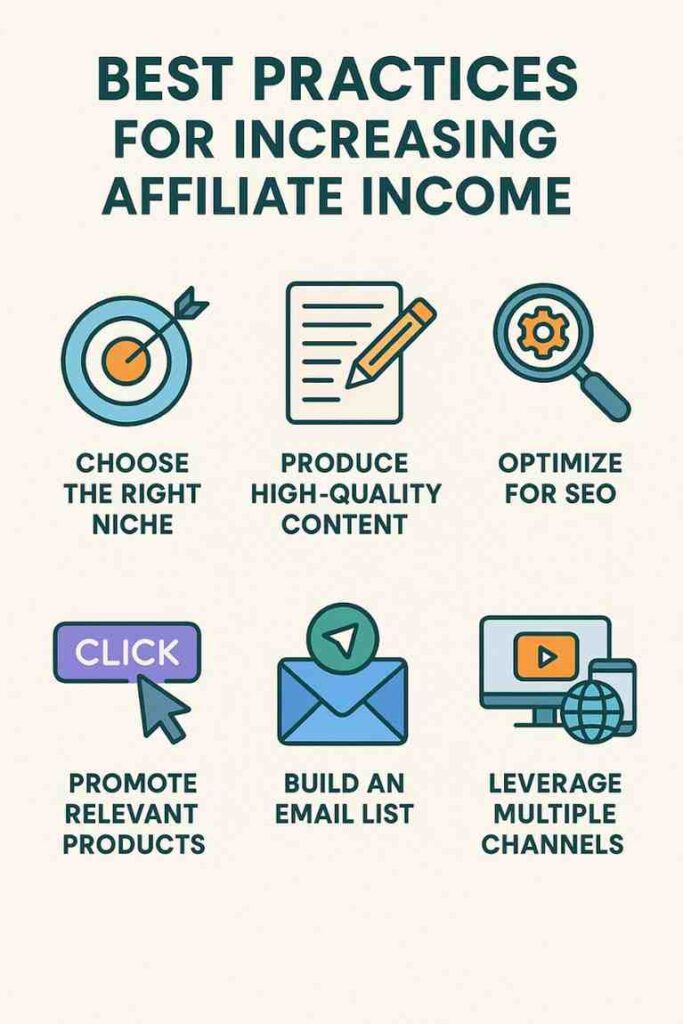
Affiliate marketing is a performance-based strategy where marketers earn commissions by promoting products or services through unique affiliate links. While affiliate marketing offers significant income potential, success requires strategic effort to maximize earnings. “Best practices” are proven techniques that optimize traffic, conversions, and revenue while building trust and sustainability. In 2025, with evolving consumer behavior, advanced tools, and search engine algorithms prioritizing user experience and E-E-A-T (Experience, Expertise, Authoritativeness, Trustworthiness), adopting these practices is essential for affiliates to thrive. This essay outlines the best practices for increasing affiliate income, detailing their implementation, benefits, challenges, and tools, followed by a practical example to illustrate their application.
Best Practices for Increasing Affiliate Income
1. Choose a Profitable and Relevant Niche
Selecting the right niche is foundational to affiliate success, as it determines your audience, competition, and earning potential.
- How to Implement:
- Research Demand: Use Google Trends (free) or Ubersuggest (free) to identify niches with consistent or growing interest (e.g., “budget tech gadgets” or “sustainable travel”).
- Assess Competition: Target sub-niches with moderate competition (e.g., “vegan fitness gear” vs. broad “fitness”) to rank faster on search engines.
- Align with Passion: Choose a niche you’re knowledgeable or passionate about to sustain content creation and authenticity.
- Select High-Paying Programs: Join programs like Amazon Associates (1–10% commissions), ShareASale, or SaaS affiliates (e.g., NordVPN at 40%) for better payouts.
- Significance: A focused niche attracts a targeted audience, reduces competition, and supports higher commissions.
- Tools: Google Keyword Planner (free), Ahrefs (~$99/month) for competition analysis.
- Benefit: Increases traffic and conversions by reaching motivated buyers.
- Challenge: Oversaturated niches require unique angles to stand out.
2. Create High-Quality, Value-Driven Content
Content is the backbone of affiliate marketing, driving traffic and persuading audiences to click affiliate links.
- How to Implement:
- Focus on User Intent: Create content addressing specific needs, such as product reviews, comparisons, or guides (e.g., “Top 5 Budget Laptops for Students 2025”).
- Be Transparent: Include FTC-compliant disclosures (e.g., “This post contains affiliate links”) to build trust.
- Add Value: Provide in-depth insights, personal experiences, or user feedback (e.g., “I tested these laptops for a month”).
- Use Visuals: Incorporate images, infographics, or videos created with Canva (free) or DaVinci Resolve (free) to enhance engagement.
- Significance: Quality content ranks higher, engages audiences, and meets Google’s E-E-A-T standards, boosting conversions.
- Tools: Grammarly (free) for polished writing, Yoast SEO (free) for content optimization.
- Benefit: Builds trust and drives long-term, evergreen traffic.
- Challenge: Time-intensive to produce consistently.
3. Optimize for Search Engine Optimization (SEO)
SEO is critical for driving organic traffic to affiliate content, reducing reliance on paid or social channels.
- How to Implement:
- Keyword Research: Target long-tail keywords with high intent (e.g., “best wireless earbuds for running 2025”) using Google Keyword Planner or Ubersuggest.
- On-Page SEO: Optimize titles, meta descriptions, headings, and URLs with keywords. Use alt text for images and internal/external links for authority.
- Technical SEO: Ensure fast load times (<3 seconds) with Google PageSpeed Insights (free), mobile optimization, and HTTPS via hosting like Bluehost (~$50/year).
- Build Backlinks: Earn links from niche sites via guest posting or community engagement (e.g., Reddit or Quora).
- Significance: Higher rankings attract targeted, high-intent traffic, increasing affiliate link clicks.
- Tools: Google Search Console (free) for ranking tracking, BuzzSumo (free trial) for backlink opportunities.
- Benefit: Cost-effective, sustainable traffic source.
- Challenge: SEO results take 3–12 months, requiring patience.
4. Diversify Traffic Sources
Relying on a single traffic source (e.g., Google) risks income loss from algorithm changes or platform bans. Diversifying ensures stability.
- How to Implement:
- Social Media: Share content on Pinterest, Instagram, or TikTok to drive niche traffic. Use Buffer (free) for scheduling.
- Email Marketing: Build a list with Mailchimp (free for 500 subscribers) using lead magnets (e.g., “Free Tech Buying Guide”).
- Paid Ads: Run low-budget Google Ads or Facebook Ads ($5–$10/day) targeting high-intent audiences.
- Communities: Engage in Reddit subreddits or Quora, linking to content subtly to avoid bans.
- Significance: Multiple channels reduce risk and amplify reach, supporting consistent traffic.
- Tools: Linktree (free) for social link management, Bitly (free) for link tracking.
- Benefit: Stabilizes income and reaches diverse audiences.
- Challenge: Managing multiple channels is time-consuming.
5. Build an Email List
Email marketing allows affiliates to nurture leads and promote offers repeatedly, increasing conversions over time.
- How to Implement:
- Create a Lead Magnet: Offer a free resource (e.g., eBook, checklist) via a landing page built with Carrd ($19/year).
- Set Up Email Sequences: Use Mailchimp to send welcome emails, educational content, and promotional offers with affiliate links.
- Segment Audiences: Tailor emails based on interests (e.g., tech vs. fitness) for personalized promotions.
- Include CTAs: Add clear calls-to-action (e.g., “Shop Now”) with affiliate links.
- Significance: Email lists provide direct access to engaged audiences, boosting repeat conversions.
- Tools: Google Docs (free) for lead magnet creation, Mailchimp for automation.
- Benefit: High ROI, as emails convert better than one-off content.
- Challenge: Building a list takes time and consistent effort.
6. Promote High-Converting Offers
Focusing on products or services with strong conversion potential maximizes earnings per click.
- How to Implement:
- Choose High-Paying Programs: Prioritize SaaS (e.g., ConvertKit at 30% recurring) or high-ticket items (e.g., laptops) over low-commission products.
- Test Offers: Use affiliate dashboards to track which products convert best (e.g., NordVPN vs. a generic gadget).
- Leverage Promotions: Highlight limited-time deals (e.g., “50% Off NordVPN This Week!”) to create urgency.
- Bundle Bonuses: Offer exclusive bonuses (e.g., a setup guide) for purchases through your link, where allowed.
- Significance: High-converting offers yield more revenue with less traffic.
- Tools: ShareASale or CJ Affiliate for program discovery, Bitly for tracking.
- Benefit: Increases earnings efficiency.
- Challenge: High-paying programs may have stricter approval processes.
7. Track and Optimize Performance
Data-driven optimization ensures affiliate campaigns remain profitable and scalable.
- How to Implement:
- Monitor Metrics: Use Google Analytics (free) for traffic insights and affiliate dashboards for clicks, conversions, and commissions.
- A/B Test: Experiment with CTAs, headlines, or landing page designs using Google Optimize (free).
- Refine Strategies: Focus on high-performing content or offers (e.g., double down on a top-ranking review).
- Update Content: Refresh posts with new prices, features, or trends to maintain relevance.
- Significance: Optimization improves ROI and identifies growth opportunities.
- Tools: Google Tag Manager (free) for tracking, Ahrefs for competitor analysis.
- Benefit: Maximizes earnings from existing traffic.
- Challenge: Requires learning analytics and testing tools.
8. Ensure Compliance and Build Trust
Compliance with program rules and transparency with audiences fosters long-term success.
- How to Implement:
- Disclose Affiliate Links: Include FTC-compliant disclosures in all content (e.g., “This post contains affiliate links, and I may earn a commission at no cost to you”).
- Follow Program Rules: Adhere to terms (e.g., Amazon prohibits direct ad links or price tracking).
- Promote Quality Products: Recommend reputable products to maintain credibility.
- Engage Authentically: Share personal experiences or honest reviews to build trust.
- Significance: Compliance avoids bans, while trust increases conversions.
- Tools: Grammarly for clear disclosures, Bitly for compliant links.
- Benefit: Protects accounts and enhances audience loyalty.
- Challenge: Staying updated on rules across programs and platforms.
Challenges of Implementing Best Practices
- Time Investment: SEO, content creation, and email nurturing require months of consistent effort.
- Learning Curve: Mastering SEO, ads, or analytics demands study, though free resources help.
- Costs: Tools like Ahrefs or paid ads strain budgets, but free alternatives exist.
- Competition: Popular niches require unique angles or sub-niches to compete.
- Algorithm Changes: Google or social platform updates can disrupt traffic, necessitating adaptability.
Benefits of Best Practices
- Sustainable Income: Evergreen content and email lists generate passive revenue.
- Scalability: Optimized strategies allow expansion into new niches or offers.
- Trust and Authority: Transparent, quality content builds a loyal audience.
- Cost-Effectiveness: Free tools and organic traffic minimize expenses.
- Data-Driven Growth: Analytics guide improvements for higher ROI.
Example: Applying Best Practices to Increase Affiliate Income
Scenario: Emma, a 23-year-old student, wants to earn $400/month promoting SaaS tools in the “productivity for students” niche. She applies best practices to build a sustainable affiliate business.
Step-by-Step Approach:
- Choose a Niche (Week 1):
- Emma selects “productivity for students,” focusing on tools like Notion and Todoist, validated by Google Trends showing high demand. She joins Notion Affiliate Program (50% commission, ~$15/sale) and Todoist Affiliate Program (25% commission, ~$10/sale) via ShareASale.
- Create Content (Weeks 2–8):
- Emma builds a blog, “StudentProductivityHub,” using WordPress.org with Bluehost ($40/year). She writes a 2,000-word comparison post, “Notion vs. Todoist: Best Productivity Apps for Students in 2025,” optimized for “Notion vs. Todoist 2025” using Ubersuggest.
- Content: Includes a comparison table, pros/cons, personal insights (“I used Notion for my study notes”), and Canva visuals. She adds an FTC disclosure and CTAs with Bitly links.
- She creates a YouTube video summarizing the post, driving 1,000 views/month.
- Optimize for SEO (Weeks 9–12):
- Emma uses Yoast SEO to optimize her post, targeting keywords like “best productivity apps for students.” She submits a sitemap via Google Search Console and ensures mobile optimization with Google PageSpeed Insights.
- She earns 10 backlinks by guest posting on study blogs and engaging on Reddit’s r/Productivity, boosting her post to Google’s page 1, attracting 2,500 visitors/month.
- Diversify Traffic (Weeks 13–16):
- Emma shares pins on Pinterest**, driving 800 visitors/month. She posts Instagram reels about productivity, gaining 1,500 followers and 200 clicks/month via Linktree.
- She runs Facebook Ads ($5/day, $150/month) targeting students interested in apps, driving 500 visitors/month.
- Build Email List (Weeks 2–20):
- Emma creates a lead magnet, “Free Student Productivity Toolkit,” using Google Docs, hosted on a Carrd landing page ($19/year). She collects 1,200 subscribers via Mailchimp, sending a 5-email sequence:
- Email 1: Delivers the toolkit.
- Email 2: Shares “5 Productivity Hacks for Students.”
- Email 3: Compares Notion and Todoist.
- Email 4: Promotes Notion’s discount.
- Email 5: Highlights Todoist’s features.
- Emails drive 150 affiliate link clicks/month at a 20% conversion rate.
- Emma creates a lead magnet, “Free Student Productivity Toolkit,” using Google Docs, hosted on a Carrd landing page ($19/year). She collects 1,200 subscribers via Mailchimp, sending a 5-email sequence:
- Promote High-Converting Offers (Ongoing):
- Emma focuses on Notion’s 50% commission due to higher conversions. She highlights limited-time deals (e.g., “Notion’s Student Plan Free for 6 Months!”) to create urgency.
- Track and Optimize (Weeks 17–24):
- Google Analytics shows 4,800 monthly visitors (2,500 SEO, 800 Pinterest, 1,500 ads). ShareASale reports 20 Notion sales ($300 commission) and 15 Todoist sales ($150 commission), totaling $450/month.
- Emma tests a new landing page CTA with Google Optimize, increasing email signups by 15%, adding 3 sales/month ($45). She updates her post with 2025 features, maintaining rankings.
- ROI: $450 – $169 (ads + Carrd + hosting) = $281 profit/month.
Analysis: Emma’s success stems from a focused niche, high-quality content, SEO, diversified traffic, email nurturing, and data-driven optimization. Free tools (Canva, Ubersuggest, Mailchimp) and low-cost Carrd and Bluehost keep expenses minimal. Her compliance and trust-building ensure sustainability, exceeding her $400/month goal.
Conclusion
Best practices for increasing affiliate income involve choosing a profitable niche, creating value-driven content, optimizing for SEO, diversifying traffic, building email lists, promoting high-converting offers, tracking performance, and ensuring compliance. These strategies maximize traffic, conversions, and revenue while fostering trust and sustainability. Challenges like time investment and competition are overcome with free tools, persistence, and optimization. Emma’s example in the productivity niche demonstrates how a beginner can earn $450/month by applying these practices, leveraging affordable resources and multi-channel strategies. In 2025, as consumers prioritize trusted, relevant content, adopting these best practices empowers affiliates to build scalable, profitable businesses in the competitive affiliate marketing landscape.