
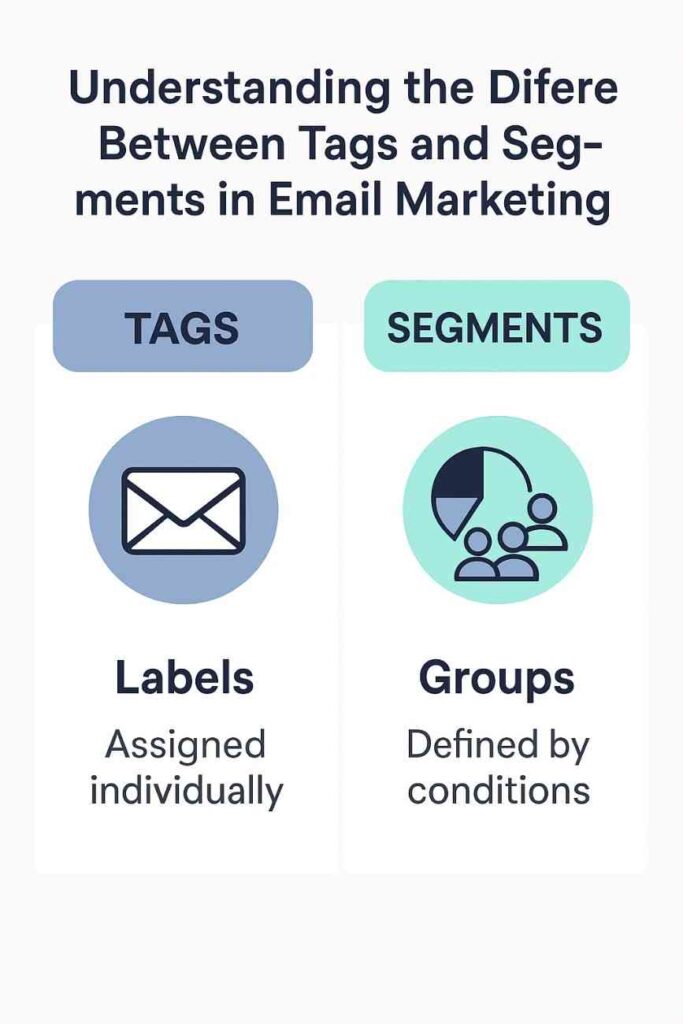
In email marketing, effectively managing and communicating with your audience hinges on organizing contacts in a way that allows for targeted, relevant messaging. Two fundamental tools for achieving this are tags and segments. While both are used to categorize and manage contacts, they serve distinct purposes, have different functionalities, and are applied in unique ways to optimize email campaigns. This article provides a comprehensive explanation of the differences between tags and segments, their use cases, benefits, and limitations, and concludes with a practical example to illustrate their application in a real-world scenario. The discussion is tailored to reflect the state of email marketing platforms in 2025, incorporating insights from modern tools and practices.
Defining Tags and Segments
Tags
Tags are descriptive labels or identifiers assigned to individual contacts in an email marketing platform. They act as metadata, providing specific, often qualitative, information about a contact’s behavior, preferences, or characteristics. Tags are typically applied manually or through automation rules based on specific actions or attributes, such as a purchase, form submission, or engagement with a campaign.
- Purpose: Tags categorize contacts based on specific actions, traits, or events, allowing for flexible and granular organization.
- Characteristics:
- Static and Individual: Tags are applied to individual contacts and remain until removed or updated.
- Flexible and Cumulative: A single contact can have multiple tags, each representing different attributes or actions (e.g., “VIP Customer,” “Attended Webinar,” “Interested in Product X”).
- Action-Based: Tags are often tied to specific interactions, such as clicking a link, making a purchase, or signing up for a newsletter.
- Non-Exclusive: Contacts can have overlapping tags without conflict, as tags are independent of one another.
- Use Cases:
- Identifying customers who completed a specific action (e.g., “Downloaded eBook”).
- Labeling contacts based on interests or preferences (e.g., “Prefers Eco-Friendly Products”).
- Tracking engagement with specific campaigns (e.g., “Opened Black Friday Email”).
- Example in Platforms: In tools like Brevo or Mailchimp, tags can be added via automation triggers (e.g., tagging a contact as “Lead” after they fill out a form) or manually during data import.
Segments
Segments are dynamic groups of contacts created based on predefined criteria or conditions. These criteria can include tags, demographic data, behavioral data, or other attributes stored in the contact database. Segments are essentially filtered lists that update automatically as contacts meet or no longer meet the specified conditions.
- Purpose: Segments enable marketers to group contacts for targeted campaigns based on shared characteristics or behaviors.
- Characteristics:
- Dynamic and Rule-Based: Segments update in real-time as contacts’ data changes (e.g., a contact enters or exits a segment when their behavior or attributes change).
- Conditional: Segments are defined by rules, such as “Contacts who opened an email in the last 30 days” or “Contacts with a purchase history over $100.”
- Group-Oriented: Segments apply to groups of contacts rather than individuals, though they rely on individual data points.
- Temporary: Contacts can move in and out of segments as their data evolves.
- Use Cases:
- Sending targeted campaigns to contacts meeting specific criteria (e.g., “All subscribers in California who purchased in the last 60 days”).
- Analyzing audience behavior, such as identifying inactive subscribers for re-engagement campaigns.
- Personalizing content for groups with shared traits, like age or location.
- Example in Platforms: In Klaviyo or ActiveCampaign, segments can be created using filters like “Has purchased Product X” AND “Lives in New York” to dynamically group contacts for a campaign.
Key Differences Between Tags and Segments
To fully grasp the distinction between tags and segments, let’s break down their differences across several dimensions:
1. Nature and Application
- Tags: Applied directly to individual contacts, often as a result of a specific action or manual input. For example, a contact who signs up for a webinar might be tagged “Webinar Attendee.” Tags are static and persist unless deliberately removed.
- Segments: Created by defining rules that filter contacts into groups. For instance, a segment might include “All contacts tagged ‘Webinar Attendee’ who also live in Europe.” Segments are dynamic and adjust automatically as contact data changes.
2. Flexibility
- Tags: Highly flexible, as multiple tags can be applied to a single contact to describe various attributes or actions. They allow for granular customization without predefined structure.
- Segments: Less flexible in terms of individual customization, as they rely on predefined conditions. However, they are powerful for creating broad groups based on complex, multi-criteria filters.
3. Automation
- Tags: Often used within automation workflows to label contacts based on triggers. For example, in Omnisend, a contact who abandons a cart might be tagged “Abandoned Cart” to trigger a follow-up email.
- Segments: Used to target groups in automation or campaigns. For instance, a segment like “Abandoned Cart in Last 24 Hours” can be used to send a time-sensitive recovery email to all qualifying contacts.
4. Scalability
- Tags: Can become unwieldy with large contact lists if not managed properly, as too many tags may lead to disorganization. However, they are excellent for micro-targeting.
- Segments: Scale well for large audiences, as they dynamically group contacts based on rules, reducing manual management. They are ideal for broad, recurring campaigns.
5. Use in Campaigns
- Tags: Best for one-off or highly specific campaigns targeting contacts with particular labels. For example, sending a thank-you email to all contacts tagged “Recent Purchaser.”
- Segments: Ideal for ongoing, dynamic campaigns targeting groups that evolve over time, such as “Engaged Subscribers” (contacts who opened emails in the last 30 days).
6. Data Management
- Tags: Require careful management to avoid clutter. For instance, a contact might accumulate dozens of tags over time, making it harder to prioritize relevant ones.
- Segments: Automatically manage group membership based on rules, reducing manual upkeep but requiring precise criteria to avoid over- or under-inclusion.
7. Examples in 2025 Platforms
- In Mailchimp, tags are used to label contacts (e.g., “VIP Customer”), while segments are created using filters like “Contacts with tag ‘VIP Customer’ who spent over $500.”
- In Klaviyo, tags might mark a contact as “Clicked Summer Sale Link,” while a segment could group “All contacts who clicked Summer Sale Link and made a purchase.”
- In HubSpot, tags (or custom properties) can denote specific actions, while segments (lists) are used for dynamic campaign targeting.
Benefits and Limitations
Tags
- Benefits:
- Granular and specific, allowing for precise tracking of individual actions or traits.
- Easy to apply via automation or manual input.
- Versatile for ad-hoc targeting or niche campaigns.
- Limitations:
- Can lead to tag overload if not managed systematically.
- Requires manual cleanup to maintain relevance.
- Less efficient for large-scale, recurring campaigns.
Segments
- Benefits:
- Dynamic and self-updating, reducing manual effort.
- Ideal for large-scale, recurring campaigns with clear criteria.
- Supports complex filtering for precise audience targeting.
- Limitations:
- Requires accurate data and well-defined rules to be effective.
- Less suited for one-off, highly specific targeting.
- May exclude contacts if criteria are too restrictive.
Example: Using Tags and Segments for an Ecommerce Campaign
Scenario: “GreenLiving,” an ecommerce store selling eco-friendly home products, uses Brevo to manage its email marketing. The store has a subscriber list of 5,000 and wants to launch a campaign to promote a new line of sustainable kitchenware.
Implementation:
- Tagging Contacts:
- GreenLiving sets up automation in Brevo to tag contacts based on specific actions:
- Customers who purchase kitchenware are tagged “Kitchenware Buyer.”
- Visitors who browse the kitchenware category but don’t purchase are tagged “Kitchenware Interest.”
- Subscribers who sign up via a newsletter popup are tagged “Newsletter Subscriber.”
- After a promotional email campaign, contacts who click a link to view the new kitchenware line are tagged “Clicked Kitchenware Promo.”
- Result: Individual contacts now have tags reflecting their interactions, such as “Kitchenware Buyer” or “Clicked Kitchenware Promo.”
- GreenLiving sets up automation in Brevo to tag contacts based on specific actions:
- Creating Segments:
- GreenLiving creates segments to target specific groups for their campaign:
- Segment 1: High-Value Kitchenware Buyers – Criteria: “Tagged ‘Kitchenware Buyer’ AND spent over $100 in the last 90 days.” This segment dynamically includes loyal customers who have made significant kitchenware purchases.
- Segment 2: Engaged Prospects – Criteria: “Tagged ‘Kitchenware Interest’ OR ‘Clicked Kitchenware Promo’ AND opened an email in the last 30 days.” This segment targets potential buyers who have shown interest but haven’t purchased.
- Segment 3: New Subscribers – Criteria: “Tagged ‘Newsletter Subscriber’ AND joined in the last 14 days.” This segment focuses on welcoming new subscribers with a promotional offer.
- Result: Segments are automatically populated and updated as contacts meet or cease to meet the criteria (e.g., a contact who makes a purchase moves from “Engaged Prospects” to “High-Value Kitchenware Buyers”).
- GreenLiving creates segments to target specific groups for their campaign:
- Campaign Execution:
- High-Value Kitchenware Buyers: GreenLiving sends a loyalty discount email offering 15% off the new kitchenware line, leveraging their purchase history to personalize the message.
- Engaged Prospects: A series of three emails is sent, starting with an educational email about sustainable kitchenware, followed by a product showcase, and ending with a limited-time 10% discount to encourage purchases.
- New Subscribers: A welcome email introduces the brand and offers a 5% discount on any kitchenware purchase, tagged with “Welcome Offer Sent” for tracking.
- Result: The campaign achieves a 30% open rate and 8% conversion rate, with segments ensuring relevant messaging and tags tracking individual interactions.
- Analytics and Refinement:
- GreenLiving uses Brevo’s analytics to monitor performance. The “High-Value Kitchenware Buyers” segment generates $3,000 in revenue, while “Engaged Prospects” converts 10% of contacts into buyers.
- Tags like “Clicked Kitchenware Promo” help identify engaged contacts for future campaigns, while segments are adjusted (e.g., tightening criteria to “spent over $150” for higher-value targeting).
Outcome: By combining tags and segments, GreenLiving delivers targeted campaigns that increase engagement and sales. Tags provide granular insights into individual behaviors, while segments enable scalable, dynamic targeting.
Conclusion
Tags and segments are complementary tools in email marketing, each serving a unique role in audience management. Tags offer granular, static labels for tracking individual actions or traits, while segments provide dynamic, rule-based groups for targeted campaigns. In 2025, platforms like Brevo, Mailchimp, and Klaviyo make it easy to leverage both, with automation and AI enhancing their effectiveness. The GreenLiving example demonstrates how tags and segments work together to create personalized, efficient campaigns. By understanding their differences and applying them strategically, marketers can maximize engagement, conversions, and ROI in a competitive digital landscape.