
Introduction
Email marketing continues to be one of the most effective digital marketing strategies, offering direct communication with customers, high ROI, and measurable results. However, as customer expectations evolve and the volume of marketing messages increases, traditional methods of email marketing are becoming less effective. Marketers now face the challenge of standing out in a crowded inbox while delivering timely, relevant, and personalized content.
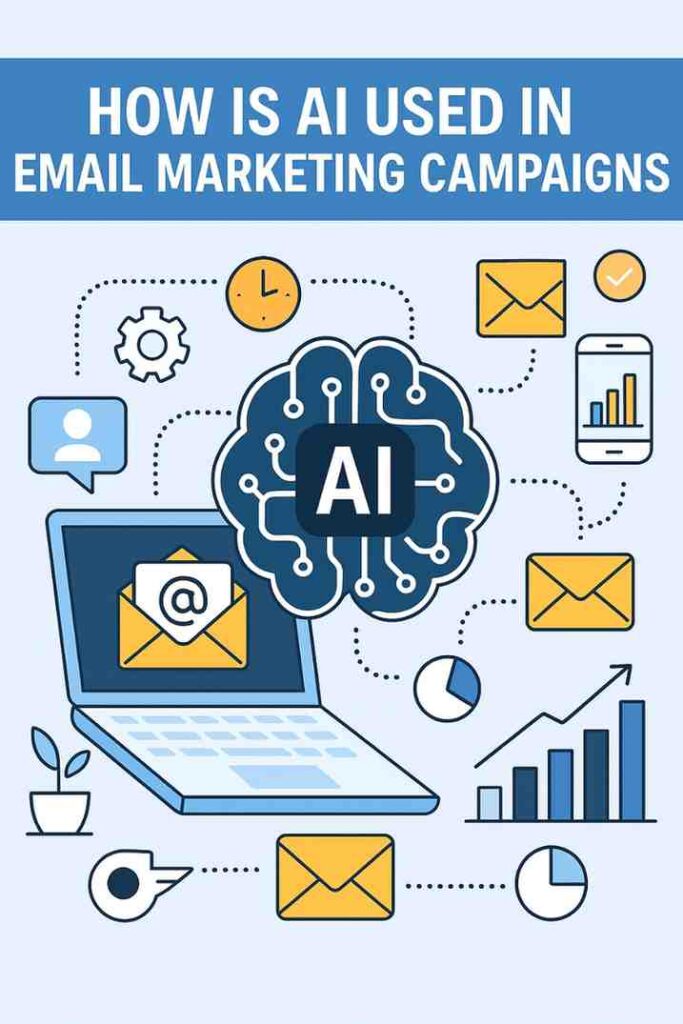
Enter Artificial Intelligence (AI) — a revolutionary force reshaping the way businesses approach email marketing. AI enables marketers to create smarter, data-driven campaigns that adapt to customer behavior in real time. By automating repetitive tasks, analyzing massive datasets, predicting user preferences, and personalizing communication at scale, AI is transforming email marketing into a highly strategic and dynamic tool.
In this comprehensive essay, we will explore how AI is used in email marketing campaigns, including the technologies involved, key applications, benefits, challenges, and a real-world example that demonstrates its impact.
Understanding AI in the Context of Email Marketing
Artificial Intelligence (AI) refers to the ability of computer systems to mimic human intelligence through machine learning, natural language processing, data analysis, and predictive algorithms. When applied to email marketing, AI uses customer data to:
-
Understand behavior patterns
-
Predict future actions
-
Customize content
-
Optimize send times
-
Increase engagement and conversions
AI empowers marketers not just to send emails, but to send the right message, to the right person, at the right time — at scale.
Key Areas Where AI is Used in Email Marketing
Let’s break down the main areas where AI is revolutionizing email marketing:
1. Personalization at Scale
Traditional personalization (e.g., using a subscriber’s name) is no longer sufficient. AI goes beyond by:
-
Analyzing user behavior (clicks, time spent on site, past purchases)
-
Predicting what content will resonate with each recipient
-
Delivering dynamic content blocks within emails based on preferences
For instance, a fashion retailer using AI can send different clothing recommendations to two users within the same campaign — one may see formal wear, while another sees casual outfits — all automated based on their browsing history.
AI tools used: Persado, Phrasee, Dynamic Yield
2. Predictive Analytics and Customer Segmentation
AI helps marketers create intelligent segments by analyzing:
-
Purchase frequency
-
Cart abandonment history
-
Browsing behavior
-
Demographics
-
Past email interactions
These insights help build predictive models such as:
-
Likelihood to purchase
-
Likelihood to unsubscribe
-
Lifetime value prediction
-
Next best offer
Instead of manually segmenting users, AI enables the system to create dynamic segments that update in real time.
AI tools used: Salesforce Einstein, Adobe Sensei, Klaviyo AI
3. Optimizing Send Times
Knowing when to send an email can be the difference between a high open rate and being buried in the inbox. AI analyzes each user’s past behavior to determine:
-
The best day and time for email delivery
-
Device usage patterns (mobile vs. desktop)
-
Frequency preferences (daily, weekly, monthly)
By sending emails at individualized optimal times, AI helps maximize engagement.
AI tools used: Seventh Sense, Sendinblue, Mailchimp AI Send Time Optimization
4. Subject Line Generation and Content Creation
AI tools are now capable of writing subject lines, headlines, and even entire email copies using natural language processing (NLP). These tools evaluate:
-
Past open rates
-
Emotional tone
-
Keyword relevance
-
Engagement history
The system tests and learns what works best, producing high-performing subject lines tailored to each user segment.
AI tools used: Phrasee, Jasper AI, Copy.ai
5. A/B Testing Automation
Instead of manually setting up A/B tests, AI can:
-
Generate multiple content variants
-
Automatically test headlines, images, CTAs, layouts
-
Analyze results in real time
-
Implement the best-performing version dynamically
This is called multivariate testing with AI, allowing much more complex and accurate optimization compared to traditional A/B testing.
AI tools used: Mailchimp AI, ActiveCampaign, HubSpot AI
6. Email Retargeting and Behavioral Triggers
AI tracks user interactions and sets up automated email workflows based on real-time behavior. For example:
-
If a user abandons a cart, they receive a follow-up email within hours
-
If a user downloads a guide, they are entered into a drip campaign with relevant follow-ups
-
If a user hasn’t opened the last 5 emails, AI pauses campaigns or sends re-engagement emails
This approach helps reduce unsubscribes and increase conversions by aligning communication with user intent.
AI tools used: Drip, Omnisend, Klaviyo, GetResponse
7. Spam Filter Avoidance
AI can help reduce the chances of emails being flagged as spam by analyzing:
-
Email structure
-
Subject line phrasing
-
Content-to-code ratio
-
User engagement levels
It suggests changes to improve inbox placement, thereby enhancing deliverability and reputation.
AI tools used: GlockApps, MailGenius, Postmark AI
8. AI Chatbots in Email Funnels
While not traditional email marketing, AI chatbots are often integrated within emails or linked through CTAs to handle:
-
FAQs
-
Appointment scheduling
-
Product recommendations
-
Upselling or cross-selling
These bots continue the customer journey, making email campaigns interactive and customer-focused.
AI tools used: Drift, ManyChat, Tars
Benefits of Using AI in Email Marketing
The integration of AI provides numerous advantages:
-
Hyper-Personalization: Tailors emails down to individual user behavior and preferences.
-
Increased Engagement: Leads to higher open and click-through rates.
-
Efficiency: Reduces manual work through automation and smart scheduling.
-
Scalability: Enables customized communication for thousands or millions of users.
-
Real-Time Adaptation: Reacts to behavior changes instantly with dynamic content and actions.
-
Better ROI: Improves customer experience, retention, and conversion rates.
Challenges of AI in Email Marketing
Despite its benefits, AI implementation comes with hurdles:
-
Data Privacy Concerns: Over-personalization may feel intrusive if not transparently managed. Compliance with GDPR and CCPA is crucial.
-
Integration Complexity: AI tools must sync with CRMs, ESPs, websites, and analytics platforms.
-
High Cost for Advanced AI Systems: Some AI platforms are expensive for small businesses.
-
Need for Quality Data: Poor data leads to poor AI results. Data hygiene and structure are critical.
-
Lack of Human Touch: Automated content may feel robotic if not properly guided by human creativity.
Real-World Example: Netflix Email Campaigns Powered by AI
Netflix is known for leveraging AI in almost every aspect of its business, including email marketing. When a subscriber logs into Netflix and begins watching content, the system starts learning their preferences. That behavior is used to:
-
Generate personalized viewing recommendations.
-
Send customized emails suggesting new releases similar to the user’s taste.
-
Use dynamic images and subject lines tied to favorite genres or actors.
For example, a user who watches a lot of thriller series may receive an email with the subject line:
“Your next binge-worthy thriller is here 🔥”
The email might include thumbnails of new thriller shows, automatically selected and arranged by AI.
Netflix uses AI to:
-
Optimize send times based on user habits
-
Adapt email frequency based on engagement
-
Automatically stop sending to unengaged users (protecting sender reputation)
As a result, Netflix’s emails feel personal and timely, leading to higher open rates, more clicks, and better customer retention.
Future Trends in AI-Powered Email Marketing
As AI technology continues to evolve, expect the following advancements:
-
Voice-Enabled Email Interactions: With smart speakers, AI may allow users to interact with email content via voice.
-
Emotion-Aware Personalization: Sentiment analysis can tailor content based on user mood and language tone.
-
Visual Recognition: AI may detect which images a user engages with most and tailor future content accordingly.
-
Cross-Channel AI: Emails will be synchronized with other channels like SMS, push notifications, and social ads for a unified experience.
-
Autonomous Campaigns: Fully AI-driven campaigns that manage, optimize, and even create themselves based on performance.
Conclusion
Artificial Intelligence is revolutionizing email marketing by enabling a level of personalization, optimization, and automation that was previously unimaginable. From crafting compelling subject lines to determining the perfect send time and delivering dynamic, user-specific content, AI empowers marketers to reach the inbox — and the hearts — of their audience more effectively.
Businesses that adopt AI-driven email marketing will not only gain a competitive edge but will also provide better experiences for their customers. As AI becomes more accessible and advanced, even small businesses and creators can harness its power to build smarter, more meaningful email campaigns.
In a world flooded with digital messages, AI is the key to standing out, fostering trust, and achieving lasting results through email marketing.