
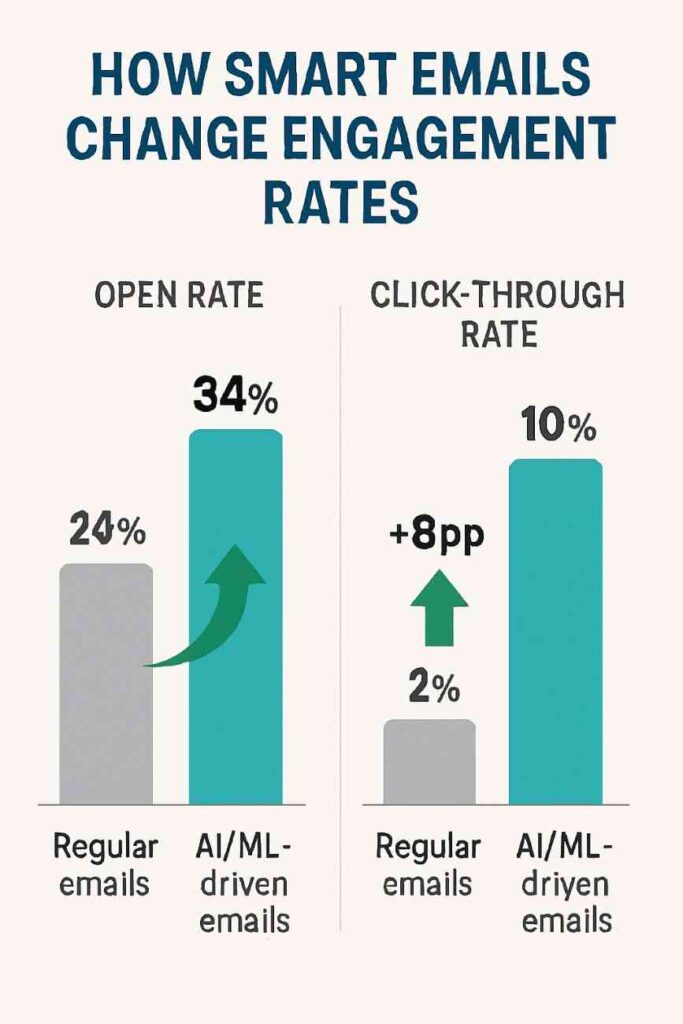
Smart emails, powered by artificial intelligence (AI) and machine learning (ML), represent a transformative shift in email marketing. By leveraging advanced algorithms, these emails analyze vast datasets to deliver highly personalized, timely, and relevant content to recipients. Unlike traditional email campaigns, which often rely on static templates and broad segmentation, AI/ML-driven emails adapt dynamically to user behavior, preferences, and context. This capability significantly impacts engagement rates—metrics such as open rates, click-through rates (CTR), and conversion rates—by enhancing relevance, optimizing delivery, and fostering stronger connections with audiences. However, the adoption of smart emails also introduces challenges, including privacy concerns and the need for robust data infrastructure. Below, we explore how smart emails change engagement rates, the mechanisms behind their effectiveness, potential drawbacks, and provide a real-world example to illustrate their impact.
Understanding Smart Emails
Smart emails utilize AI and ML to automate and optimize various aspects of email marketing. Key features include:
- Predictive Personalization: ML algorithms analyze user data—such as browsing history, purchase patterns, and email interactions—to predict preferences and tailor content. For example, an e-commerce platform might recommend products based on a user’s recent searches.
- Dynamic Content: AI enables emails to adapt in real-time, displaying different images, offers, or text based on user behavior or context. For instance, a travel agency might show flight deals specific to a user’s location.
- Optimal Timing: AI determines the best time to send emails by analyzing when users are most likely to engage, increasing the likelihood of opens and clicks.
- Subject Line Optimization: ML tests and refines subject lines to maximize open rates, using natural language processing (NLP) to craft compelling, personalized phrases.
- Behavioral Triggers: AI triggers emails based on specific actions, such as cart abandonment or website visits, ensuring timely and relevant communication.
- Segmentation and Clustering: ML creates granular audience segments by identifying patterns in data, allowing for hyper-targeted campaigns.
These capabilities make smart emails more responsive and user-centric than traditional methods, directly influencing engagement rates.
How Smart Emails Boost Engagement Rates
1. Enhanced Personalization
Personalization is a key driver of engagement, and AI/ML takes it to new levels. Traditional personalization might involve inserting a recipient’s name or segmenting by broad demographics, but smart emails use predictive models to deliver content tailored to individual preferences. For example, Netflix uses AI to recommend shows in emails based on viewing history, leading to higher CTRs as users are more likely to engage with relevant suggestions.
Studies show that personalized emails improve engagement significantly. According to a 2023 HubSpot report, personalized subject lines boost open rates by 26%, while tailored content increases CTRs by 14%. AI enhances this by continuously learning from user interactions, refining recommendations over time. This dynamic personalization fosters a sense of relevance, encouraging users to open, click, and convert.
2. Optimized Send Times
Timing is critical in email marketing. AI analyzes historical engagement data to predict when each recipient is most likely to open an email, such as during lunch breaks or evenings. By sending emails at these optimal times, businesses can increase open rates. A 2022 Campaign Monitor study found that emails sent at AI-optimized times saw open rates 20% higher than those sent at generic times.
For example, a retailer might use AI to send promotional emails to a user who typically checks their inbox at 7 PM, ensuring the message appears at the top of the inbox. This precision reduces the chance of emails being ignored or buried, directly boosting engagement.
3. Dynamic and Relevant Content
Smart emails adapt content in real-time based on user behavior or external factors like location or weather. For instance, a clothing retailer might send an email featuring raincoats to users in rainy regions while promoting sunglasses to those in sunny areas. This relevance increases the likelihood of clicks and conversions.
Dynamic content also allows for A/B testing at scale. AI can test multiple variations of an email—such as different images or calls-to-action—and automatically prioritize the best-performing version. A 2021 Salesforce report noted that dynamic content emails achieve 22% higher CTRs than static ones, as they align more closely with user needs.
4. Behavioral Triggers
AI-driven trigger emails respond to specific user actions, such as abandoning a cart, signing up for a newsletter, or browsing a product page. These emails are highly relevant because they address the user’s immediate context. For example, an abandoned cart email with a discount code can recover lost sales by prompting the user to complete their purchase.
Trigger emails are particularly effective, with open rates as high as 45% and CTRs of 10–20%, according to a 2023 Mailchimp study. AI enhances these by personalizing the trigger (e.g., recommending similar products) and optimizing delivery timing, further increasing engagement.
5. Improved Subject Lines
Subject lines are the first impression of an email, and AI uses NLP to craft compelling, personalized versions. By analyzing past open rates and user preferences, ML algorithms generate subject lines that resonate. For instance, an AI might choose “Your Exclusive 20% Off Deal, Sarah!” over a generic “Save Today!” based on data showing personalized subject lines perform better.
A 2022 Experian report found that AI-optimized subject lines increase open rates by up to 15%. This small but critical improvement ensures more emails are seen, setting the stage for higher engagement.
6. Advanced Segmentation
ML enables sophisticated audience segmentation by identifying patterns in data that humans might miss. For example, an AI might cluster users based on subtle behaviors, like frequent late-night browsing or preference for eco-friendly products. This allows for hyper-targeted campaigns that feel bespoke.
A 2023 DMA study showed that emails sent to AI-segmented audiences have 30% higher engagement rates than those sent to manually segmented lists. By ensuring content aligns with specific user groups, smart emails drive more clicks and conversions.
Challenges and Drawbacks
While smart emails significantly boost engagement, they come with challenges:
- Privacy Concerns: AI relies on extensive data collection, which can feel intrusive if not handled transparently. Regulations like GDPR and CCPA require explicit consent, and non-compliance can lead to fines or reputational damage. A 2023 Pew Research study found that 64% of consumers worry about how companies use their data, highlighting the need for ethical practices.
- Data Quality: AI’s effectiveness depends on accurate, high-quality data. Poor data can lead to irrelevant recommendations, reducing engagement. For example, suggesting winter coats to users in tropical climates could frustrate recipients.
- Cost and Complexity: Implementing AI/ML requires investment in technology, talent, and infrastructure. Small businesses may struggle to adopt these tools, limiting their ability to compete.
- Over-Reliance on Automation: Excessive automation can make emails feel impersonal if not balanced with human oversight. Users may disengage if they sense a lack of authenticity.
To mitigate these challenges, businesses must prioritize transparency, maintain robust data hygiene, and blend AI with human creativity.
Example: A Fitness App’s Smart Email Success
To illustrate the impact of smart emails, consider “FitPulse,” a fitness app offering workout plans and nutrition advice. Facing stagnant engagement rates (15% open rates, 2% CTR), FitPulse adopts an AI-driven email platform to revitalize its campaigns.
The platform uses ML to analyze user data, including workout frequency, fitness goals, and app interactions. FitPulse implements several AI features:
- Personalized Recommendations: Emails suggest workout plans based on users’ goals (e.g., weight loss or muscle gain) and past activity. For example, a user who frequently logs cardio sessions receives a “5K Training Plan” email.
- Dynamic Content: Emails adapt based on user progress. A user nearing a fitness milestone receives a congratulatory message with a tailored reward, like a discount on premium features.
- Optimal Timing: AI identifies when users are most active in the app (e.g., mornings) and sends emails accordingly, boosting open rates.
- Trigger Emails: Users who haven’t logged a workout in a week receive a motivational email with a personalized tip, such as “Try this 10-minute yoga session, Emma!”
- Subject Line Optimization: AI tests subject lines like “Your Next Workout Awaits!” versus “Emma, Crush Your Goals Today!” and prioritizes the higher-performing option.
Within three months, FitPulse’s engagement rates soar: open rates rise to 35%, CTRs increase to 8%, and conversions (premium subscriptions) grow by 20%. The AI’s ability to deliver relevant, timely content resonates with users, fostering loyalty. For instance, one user, Emma, credits a trigger email for re-engaging her after a lapse, leading to a premium subscription.
However, FitPulse faces a challenge when some users express discomfort with the app’s data use, unaware that their workout logs were analyzed. To address this, FitPulse updates its privacy policy, adds a clear opt-in for personalized emails, and includes a “manage preferences” link in every email. These steps rebuild trust, ensuring sustained engagement.
This example demonstrates how smart emails can transform engagement by leveraging AI’s precision, while also highlighting the importance of transparency to avoid alienating users.
Strategies for Maximizing Smart Email Impact
To harness smart emails effectively, businesses should:
- Ensure Transparency: Clearly disclose data use and obtain explicit consent to build trust.
- Maintain Data Quality: Regularly clean and update datasets to ensure accurate personalization.
- Balance Automation and Humanity: Use AI for optimization but incorporate human creativity in content design.
- Monitor Performance: Continuously analyze engagement metrics to refine AI models.
- Test Incrementally: Start with small AI-driven campaigns to gauge user response before scaling.
By adopting these practices, businesses can maximize engagement while mitigating risks.
Conclusion
Smart emails, driven by AI and ML, revolutionize engagement rates by delivering personalized, timely, and relevant content. Through predictive personalization, optimized timing, dynamic content, behavioral triggers, and advanced segmentation, these emails achieve open rates, CTRs, and conversions far surpassing traditional methods. Studies consistently show improvements of 15–30% across key metrics, underscoring AI’s transformative potential. However, challenges like privacy concerns and data quality require careful management. The case of FitPulse illustrates how smart emails can boost engagement when executed thoughtfully, while also highlighting the need for transparency to maintain user trust. By leveraging AI responsibly, businesses can forge stronger connections with their audiences, driving sustained engagement and growth.