
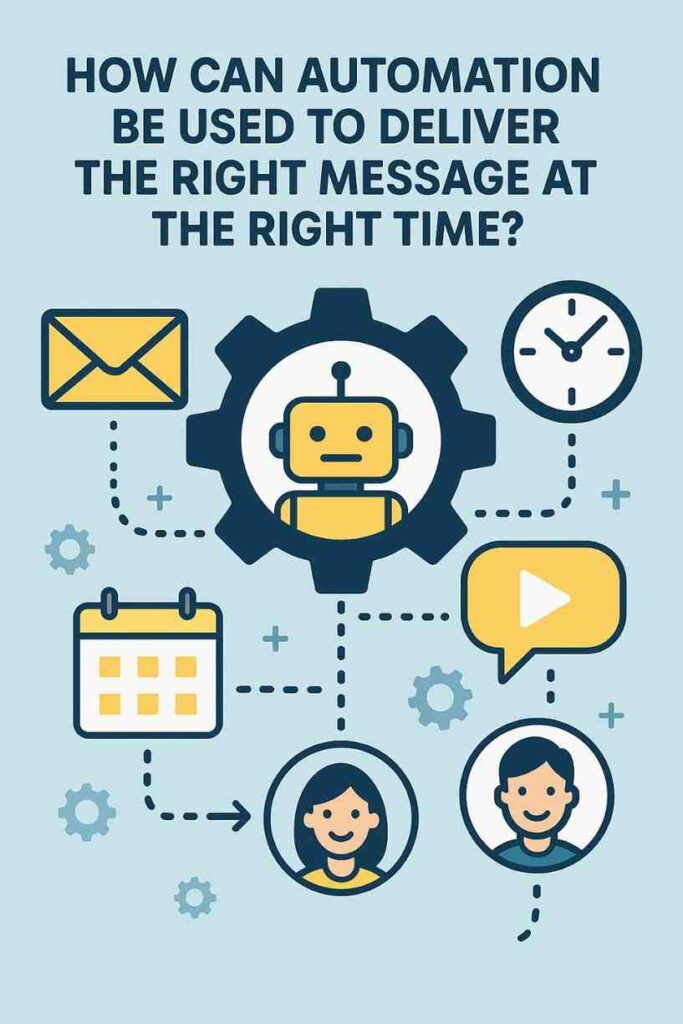
In the ever-evolving digital landscape, delivering personalized communication to the right audience at the right time is no longer optional—it is essential. Today’s consumers expect seamless, relevant, and timely interactions with brands. This level of efficiency and personalization would be impossible to maintain manually at scale, which is where automation steps in as a game-changer. Automation in marketing—especially in email marketing and customer relationship management (CRM)—allows businesses to send highly targeted and contextually relevant messages based on a variety of triggers, behaviors, and data points.
This article explores how automation can be used to deliver the right message at the right time, why it matters, the technology behind it, practical strategies for implementation, and a real-world example that demonstrates its effectiveness.
Understanding Marketing Automation
Marketing automation is the process of using software tools and systems to streamline, automate, and measure marketing tasks and workflows. The primary goal is to increase efficiency, provide a better user experience, and ultimately, boost conversions and revenue.
One of the most powerful applications of automation is in message delivery—sending emails, SMS, push notifications, or even social media messages that are highly relevant to the individual recipient’s journey. These messages are triggered by actions or conditions such as signups, purchases, inactivity, browsing behavior, birthdays, location, or expressed interests.
Why Delivering the Right Message at the Right Time Matters
Delivering a message at the perfect moment can dramatically enhance its impact. Here’s why timing and relevance are crucial:
-
Increased Engagement: People are more likely to engage with content that resonates with their immediate needs or interests.
-
Improved Customer Experience: Timely communication fosters trust and loyalty by showing the brand understands and anticipates the customer’s needs.
-
Higher Conversion Rates: Strategic timing and personalization increase the likelihood of conversions, whether that means making a purchase, signing up for a webinar, or downloading a guide.
-
Reduced Churn: Customers who feel understood are less likely to unsubscribe or disengage.
To achieve this, businesses need to go beyond static content and adopt behavior-driven, automated communication strategies.
How Automation Delivers the Right Message at the Right Time
The heart of successful marketing automation lies in data, triggers, and personalized workflows. Let’s explore how automation is applied step-by-step:
1. Collecting and Analyzing Customer Data
Before delivering messages, businesses need to gather comprehensive data about their customers. This can include:
-
Demographic data (age, location, gender)
-
Behavioral data (website visits, product views, email opens, click-throughs)
-
Transactional data (purchase history, average order value)
-
Engagement data (content consumed, frequency of interaction)
-
CRM data (lifecycle stage, sales interactions)
Modern tools like Customer Data Platforms (CDPs), CRM software, and email marketing tools collect, organize, and analyze this data to create user profiles or segments.
2. Defining Triggers
Triggers are specific actions or conditions that initiate an automated message. These include:
-
A user signing up for a newsletter
-
Abandoning a shopping cart
-
Viewing a particular product page
-
Being inactive for a set period (e.g., 30 days)
-
Completing a purchase
-
Reaching a loyalty milestone
-
Birthday or anniversary date
Each of these triggers reflects a moment of opportunity when a message can be sent to move the user closer to conversion or re-engagement.
3. Setting Up Automated Workflows
Using email marketing tools like HubSpot, ActiveCampaign, Klaviyo, Mailchimp, or Drip, businesses can create automated workflows. These workflows are essentially “if-this-then-that” scenarios that define:
-
What the trigger is
-
What message to send
-
When to send it
-
Whether to send follow-ups
-
How to segment responses and adjust future messages
For instance, if a user clicks on a pricing page but doesn’t buy, a follow-up email with a discount or case study might be triggered after 24 hours.
4. Personalizing the Message
Automation systems allow for deep personalization using dynamic content. You can personalize:
-
Subject lines (“[First Name], here’s a 20% discount just for you!”)
-
Email body content
-
Product recommendations based on browsing or purchase history
-
Offers or incentives
-
Language, tone, and visuals
Advanced platforms can use AI-driven recommendations to further tailor messages based on past behaviors and predicted preferences.
5. Testing and Optimization
Automation platforms often come with A/B testing tools, allowing marketers to test subject lines, content, call-to-actions (CTAs), and timing to see which version performs best. This continuous optimization ensures the messages remain effective and impactful.
Example: Automation in Action—An eCommerce Scenario
Let’s illustrate how automation helps deliver the right message at the right time with an example from the eCommerce sector.
Business: An online fashion retailer.
Goal: Increase sales, reduce cart abandonment, and improve customer retention.
Step 1: Data Collection
The retailer uses website analytics and customer behavior tracking. They track:
-
Pages visited (e.g., dresses, shoes, accessories)
-
Items added to cart
-
Checkout abandonment
-
Past purchase history
-
Email open and click rates
Step 2: Create Segments and Triggers
The retailer identifies several key triggers:
-
User adds an item to the cart but does not check out within 1 hour
-
User visits a specific category three times in a week
-
User hasn’t purchased in 60 days
-
User’s birthday is approaching
Step 3: Set Up Automated Campaigns
Campaign 1: Cart Abandonment
-
Trigger: Cart abandoned for 1 hour
-
Message 1: Reminder email with a photo of the item and free shipping
-
Message 2 (after 24 hours): Email offering 10% off if the purchase is completed within 48 hours
Campaign 2: Browsing Behavior
-
Trigger: User views “summer dresses” category multiple times
-
Message: Email with top-rated summer dresses and a style guide
Campaign 3: Win-Back Campaign
-
Trigger: Inactive user for 60 days
-
Message: “We miss you!” email with a special loyalty discount and a new arrivals catalog
Campaign 4: Birthday Automation
-
Trigger: Birthday in 7 days
-
Message: Email with a birthday greeting and a 20% discount code valid for the user’s birthday week
Step 4: Monitor and Optimize
The retailer tracks:
-
Open and click rates
-
Conversion rate from emails
-
Overall revenue generated from automation
-
Which email sequences perform best
They continue to refine their timing, content, and segmentation based on this data.
Channels Where Automation Delivers Messages
Automation isn’t limited to emails. Brands now use multi-channel marketing automation to ensure the right message reaches users where they’re most active. Common channels include:
-
Email
-
SMS
-
Push Notifications
-
In-app Messaging
-
Social Media DMs (via bots)
-
Web Popups
-
Retargeting Ads
For example, if a user browses a product but doesn’t act, they might receive:
-
An email within an hour
-
A reminder SMS the next day
-
A push notification via mobile app two days later
-
A retargeting ad on Facebook after three days
Each of these is automated and timed precisely based on user behavior.
Benefits of Automated, Timed Messaging
-
Scalability: Engage thousands or millions of users without manual work.
-
Consistency: Ensure every user receives timely and brand-consistent messages.
-
Precision: Tailor messages based on real-time actions and data.
-
ROI Boost: Automation increases conversion rates and reduces missed opportunities.
-
Customer Satisfaction: Personalization and timing enhance user experience and brand loyalty.
Common Mistakes to Avoid
Despite its advantages, poor implementation can reduce automation’s effectiveness. Pitfalls include:
-
Over-automation: Sending too many messages can annoy users.
-
Poor segmentation: One-size-fits-all messaging leads to low engagement.
-
Lack of testing: Failing to A/B test and refine strategies reduces impact.
-
Ignoring timing preferences: Sending messages at odd hours can result in unsubscriptions.
-
Not updating workflows: User preferences and trends change—automations should evolve too.
Conclusion
Delivering the right message at the right time isn’t just a marketing cliché—it’s a critical strategy enabled and perfected through automation. With the power to analyze behavior, segment audiences, personalize content, and schedule messages with pinpoint precision, automation transforms how businesses engage their audiences. Whether it’s a welcome email, a timely reminder, or a re-engagement campaign, automation ensures that each message lands at the moment it matters most.
By implementing intelligent automation workflows, businesses can meet their customers’ expectations, drive higher engagement, and ultimately, increase revenue. It’s not about sending more messages—it’s about sending the right messages, to the right people, at the right time.