
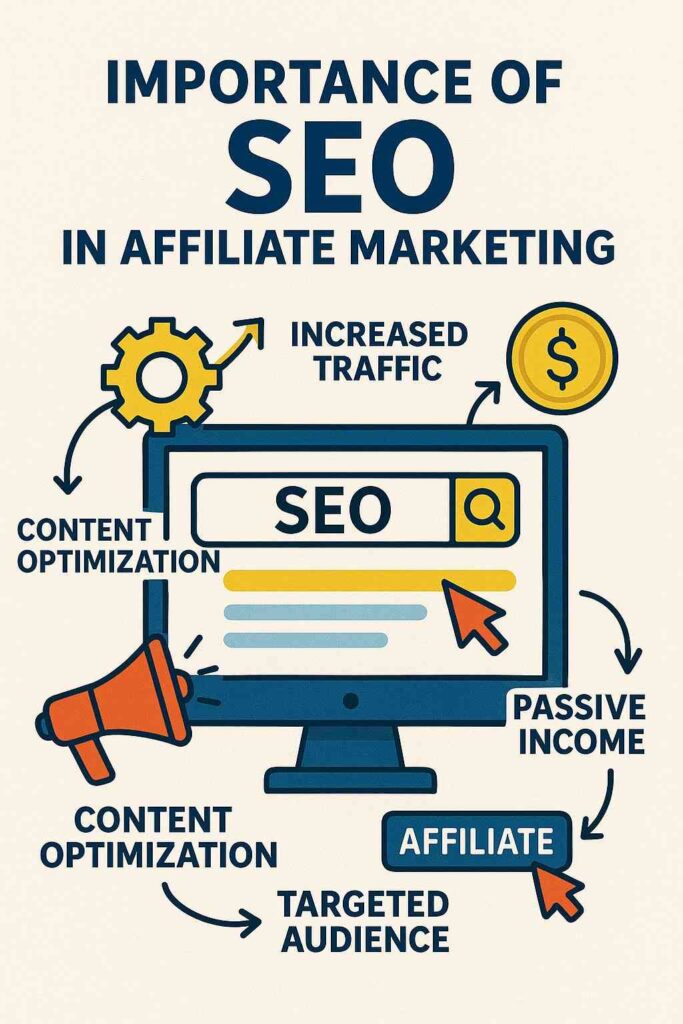
Search Engine Optimization (SEO) is a cornerstone of digital marketing, and its significance in affiliate marketing cannot be overstated. SEO involves optimizing online content to rank higher on search engines like Google, Bing, or Yahoo, thereby increasing organic (unpaid) traffic to a website or platform. For affiliate marketers, who earn commissions by promoting products or services through unique links, SEO is a critical strategy for driving targeted, high-intent traffic to their content, ultimately boosting conversions and revenue. In 2025, with search engines evolving and competition intensifying, mastering SEO is essential for affiliates to stand out in crowded niches. This essay explores the importance of SEO in affiliate marketing, detailing its benefits, strategies, challenges, and integration with affiliate campaigns, followed by a practical example to illustrate its application.
Why SEO Is Crucial in Affiliate Marketing
Affiliate marketing thrives on attracting an audience to click affiliate links and complete desired actions, such as purchases or signups. Unlike paid advertising, which requires ongoing investment, SEO offers a cost-effective, sustainable way to generate traffic over time. Its importance in affiliate marketing stems from several key factors:
- Drives Organic Traffic: Organic search accounts for over 50% of website traffic, per 2025 industry data, making it a primary source for affiliates. High-ranking content attracts visitors actively searching for solutions, increasing the likelihood of clicks and conversions.
- Targets High-Intent Audiences: SEO focuses on keywords that reflect user intent (e.g., “best budget laptops 2025”), ensuring affiliates reach people ready to buy or engage, unlike broad social media audiences.
- Builds Long-Term Assets: Well-optimized content, such as blog posts or YouTube videos, can rank for years, providing evergreen traffic and passive income with minimal maintenance.
- Enhances Credibility: High search rankings signal trust and authority to users, making them more likely to trust affiliate recommendations, especially in niches like finance or health.
- Cost-Effective: SEO requires time and effort but minimal financial investment compared to paid ads, making it ideal for beginners or students with limited budgets.
- Complements Other Channels: SEO integrates with content marketing, social media, and email strategies, amplifying overall affiliate campaign performance.
Key SEO Strategies for Affiliate Marketing
To leverage SEO effectively, affiliates must implement strategies tailored to search engine algorithms and user behavior. In 2025, Google’s emphasis on E-E-A-T (Experience, Expertise, Authoritativeness, Trustworthiness) and user experience (e.g., page speed, mobile optimization) shapes these strategies.
1. Keyword Research
Keyword research identifies terms and phrases potential customers use to find products or solutions, guiding content creation.
- How It Works: Use tools like Google Keyword Planner (free), Ubersuggest (free), or Ahrefs (~$99/month) to find keywords with high search volume and low competition. Focus on long-tail keywords (e.g., “best wireless earbuds for running 2025”) that reflect specific intent.
- Importance: Targets niche audiences, increasing conversion rates. For example, ranking for “best VPN for streaming” attracts users likely to sign up for NordVPN via an affiliate link.
- Best Practice: Balance informational (e.g., “how to choose a VPN”) and commercial (e.g., “best VPN deals 2025”) keywords to capture users at different funnel stages.
2. High-Quality Content Creation
Content is the vehicle for embedding affiliate links and ranking on search engines. Quality content aligns with user intent and Google’s E-E-A-T guidelines.
- How It Works: Create blog posts, reviews, comparisons, or guides that provide value (e.g., “Top 5 Budget Laptops for Students”). Include affiliate links naturally within product mentions or CTAs.
- Importance: Engages users, reduces bounce rates, and signals expertise, boosting rankings. Evergreen content (e.g., “best web hosting providers”) generates traffic long-term.
- Best Practice: Use Grammarly (free) for polished writing, Canva (free) for visuals, and optimize for readability with short paragraphs and subheadings.
3. On-Page SEO Optimization
On-page SEO involves optimizing individual pages to improve rankings and user experience.
- How It Works:
- Title Tags and Meta Descriptions: Include target keywords (e.g., “Best Budget Laptops 2025”) and compelling CTAs.
- Headings (H1, H2): Structure content with keyword-rich headings.
- URL Structure: Use clean, keyword-focused URLs (e.g., /best-budget-laptops-2025).
- Internal and External Links: Link to related content or authoritative sources to enhance credibility.
- Image Optimization: Use descriptive alt text and compress images for faster loading.
- Importance: Signals relevance to search engines and improves user experience, reducing bounce rates.
- Best Practice: Use Yoast SEO (free) for WordPress to guide on-page optimization.
4. Technical SEO
Technical SEO ensures a website is crawlable, fast, and user-friendly, critical for ranking in 2025.
- How It Works:
- Mobile Optimization: Ensure responsive design, as 60%+ of searches are mobile.
- Page Speed: Optimize with tools like Google PageSpeed Insights (free) to achieve load times under 3 seconds.
- SSL Certificate: Secure the site with HTTPS for trust and ranking benefits.
- Sitemap and Robots.txt: Submit a sitemap via Google Search Console (free) to aid crawling.
- Importance: Poor technical performance (e.g., slow loading) hurts rankings and user retention, reducing affiliate link clicks.
- Best Practice: Use free hosting like Wix or affordable options like Bluehost (~$50/year) with built-in SSL.
5. Off-Page SEO and Backlinks
Off-page SEO builds a site’s authority through external signals, primarily backlinks from reputable websites.
- How It Works: Earn backlinks by guest posting, creating shareable content, or engaging in niche communities (e.g., Reddit, X). For example, a guest post on a tech blog linking to your laptop review boosts authority.
- Importance: Backlinks signal trust to Google, improving rankings, especially in competitive niches like tech or finance.
- Best Practice: Use BuzzSumo (free trial) to find link-building opportunities and focus on quality over quantity.
6. Local SEO (Optional)
For affiliates promoting location-specific offers (e.g., travel deals), local SEO targets regional searches.
- How It Works: Optimize for keywords like “best travel agencies in New York” and create Google My Business profiles if applicable.
- Importance: Captures local audiences with high purchase intent.
- Best Practice: Use Google Trends (free) to identify regional demand.
Benefits of SEO in Affiliate Marketing
- Cost-Effective Traffic: Unlike paid ads, SEO delivers free traffic after initial effort, ideal for low-budget affiliates.
- Sustainable Income: High-ranking content generates passive income for months or years.
- Targeted Reach: Attracts users actively seeking solutions, improving conversion rates.
- Scalability: Affiliates can create more content to target additional keywords, expanding reach.
- Competitive Edge: Strong SEO helps overtake competitors in search results, capturing market share.
- Trust and Authority: High rankings enhance credibility, crucial for niches under Google’s YMYL (Your Money, Your Life) scrutiny, like finance or health.
Challenges of SEO in Affiliate Marketing
- Time-Intensive: Ranking content takes 3–12 months, requiring patience and consistency.
- Algorithm Updates: Google’s frequent updates (e.g., core updates in 2025) can shift rankings, necessitating adaptability.
- Competition: Popular niches like tech or health are crowded, requiring niche focus (e.g., “vegan fitness gear” vs. “fitness”).
- Learning Curve: Mastering SEO tools and strategies demands study, though free resources abound.
- E-E-A-T Compliance: Affiliates must demonstrate expertise and transparency, especially in YMYL niches, to avoid penalties.
Example: Using SEO in Affiliate Marketing for a Tech Niche
Scenario: Maya, a 21-year-old student, wants to earn $300/month promoting tech gadgets via affiliate marketing. She focuses on “budget tech for students” and uses SEO to drive traffic to her blog.
Step-by-Step Approach:
- Choose a Niche and Program (Week 1):
- Maya selects “budget tech for students,” targeting gadgets like headphones and laptops. She joins Amazon Associates (4% commissions) and Best Buy’s affiliate program via Impact (0.5–4% commissions).
- Set Up a Blog (Weeks 2–3):
- Maya creates a blog, “StudentTechHub,” using WordPress.org with Bluehost hosting ($50/year) and a free theme. She installs Yoast SEO (free) and Google Analytics (free) for optimization and tracking.
- Keyword Research (Week 4):
- Using Google Keyword Planner (free) and Ubersuggest (free), Maya identifies long-tail keywords: “best budget headphones for students 2025” (500 searches/month, low competition) and “best laptops under $500” (1,000 searches/month).
- She plans content around informational (“how to choose student headphones”) and commercial (“best budget headphones”) keywords.
- Create Optimized Content (Weeks 5–12):
- Maya writes a 1,500-word post, “Top 7 Budget Headphones for Students in 2025,” optimized with:
- Title Tag: “Best Budget Headphones for Students in 2025 [Top Picks]”
- Meta Description: “Find the best budget headphones for students in 2025. Our top 7 picks include Sony, JBL, and more. Shop now!”
- Headings: H2s like “Why Students Need Budget Headphones” and “Top Picks.”
- Affiliate Links: Embedded naturally for Sony and JBL headphones (Amazon, Best Buy).
- Images: Optimized with alt text (e.g., “Sony budget headphones”) using Canva (free).
- She creates a second post, “Best Laptops Under $500 for Students,” with similar optimization.
- Both posts include internal links to each other and external links to tech blogs for authority.
- Maya writes a 1,500-word post, “Top 7 Budget Headphones for Students in 2025,” optimized with:
- Technical SEO (Week 13):
- Maya uses Google PageSpeed Insights to optimize load time (under 3 seconds) by compressing images. She submits a sitemap via Google Search Console and ensures HTTPS via Bluehost’s free SSL.
- Off-Page SEO (Weeks 14–20):
- Maya guest posts on a tech blog, linking to her headphones article. She shares posts on Reddit’s r/FrugalTech and X, earning 10 backlinks from niche forums.
- She creates Pinterest pins with Canva, driving 500 monthly visitors to her blog.
- Track and Optimize (Weeks 21–24):
- By month six, Maya’s headphones post ranks on Google’s page 1, attracting 2,000 visitors/month. Her laptop post ranks on page 2, adding 1,000 visitors/month.
- Google Analytics shows a 15% click-through rate to affiliate links (450 clicks/month). Amazon reports 30 headphone sales ($1,500 total, $60 commission at 4%), and Best Buy reports 10 laptop sales ($5,000 total, $200 commission at 4%), totaling $260/month.
- Maya updates her headphones post with 2025 trends and creates a new post, “Best Wireless Earbuds for Studying,” targeting a related keyword, pushing earnings to $310/month.
Analysis: Maya’s success hinges on SEO-driven organic traffic, leveraging free tools (Google Keyword Planner, Yoast, Canva) and affordable hosting ($50/year). Her long-tail keyword focus and E-E-A-T-compliant content (reviews, disclosures) ensure high rankings and trust. Pinterest and backlinks amplify traffic, while analytics guide optimization. Maya exceeds her $300/month goal, demonstrating SEO’s power to drive sustainable affiliate income.
Best Practices for SEO in Affiliate Marketing
- Focus on Long-Tail Keywords: Target specific, low-competition terms to rank faster.
- Create Evergreen Content: Prioritize topics with lasting demand (e.g., “best web hosting”).
- Optimize for User Experience: Ensure fast, mobile-friendly pages with clear CTAs.
- Build Authority: Use backlinks, disclosures, and expert content to meet E-E-A-T standards.
- Track Performance: Use Google Analytics and affiliate dashboards to refine strategies.
- Stay Updated: Follow X accounts like @SEMRush or blogs like Moz for 2025 SEO trends.
Conclusion
SEO is a vital component of affiliate marketing, offering a cost-effective, sustainable way to drive targeted, high-intent traffic to affiliate content. By optimizing for keywords, creating quality content, and addressing technical and off-page factors, affiliates can achieve high search rankings, build trust, and maximize commissions. Benefits like long-term traffic and scalability make SEO ideal for beginners and seasoned marketers alike, though challenges like time investment and competition require persistence. Maya’s example in the tech niche shows how a student can use SEO to earn $310/month with minimal costs, leveraging free tools and strategic content. In 2025, as search engines prioritize user experience and authority, mastering SEO remains essential for affiliate marketers to thrive in the competitive digital landscape, ensuring consistent, passive income through organic traffic.