
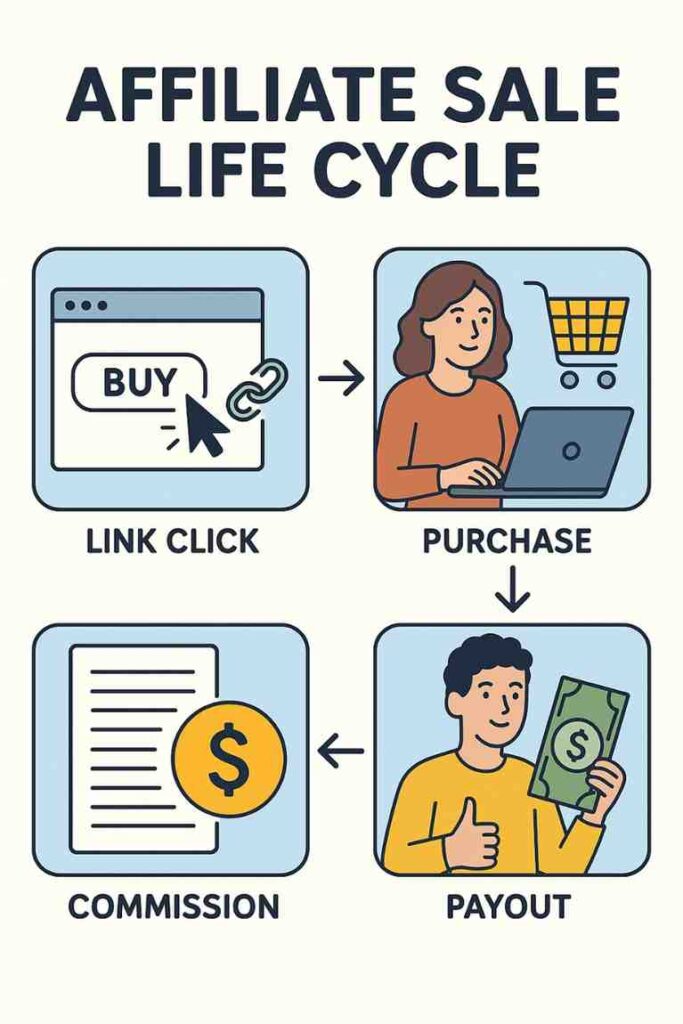
The Life Cycle of an Affiliate Sale: From Link Click to Payout
Affiliate marketing is a performance-based marketing model where affiliates earn commissions by promoting products or services. The life cycle of an affiliate sale encompasses all the steps from the moment a potential customer clicks an affiliate link to the affiliate receiving their payout. This process involves multiple stakeholders, including the affiliate, the merchant, the affiliate network, and the customer, and relies on sophisticated tracking systems to ensure accurate attribution and payment. Below, we explore the life cycle of an affiliate sale in detail, covering each stage, its significance, and potential challenges, followed by a practical example to illustrate the process.
Overview of the Affiliate Sale Life Cycle
The life cycle of an affiliate sale can be broken down into several key stages:
- Affiliate Link Click
- Tracking and Attribution
- Customer Action (Conversion)
- Sale Validation
- Commission Calculation
- Payout Processing
Each stage is critical to ensuring the affiliate is fairly compensated for their efforts, and the process is designed to maintain transparency and trust among all parties.
Stage 1: Affiliate Link Click
The life cycle begins when a potential customer clicks an affiliate’s unique referral link. Affiliates promote these links through various channels, such as blogs, social media, YouTube videos, email campaigns, or paid advertisements. The link is typically embedded in content that provides value, such as a product review, tutorial, or recommendation, to encourage clicks.
Mechanics:
- The affiliate link contains a unique identifier (e.g., an affiliate ID or tracking code) that ties the click to the specific affiliate.
- When clicked, the link directs the user to the merchant’s website, often a product page, landing page, or checkout page.
- A tracking cookie is placed on the user’s browser to record the affiliate’s referral. Cookies have a predefined duration (e.g., 30 days), meaning the affiliate can still earn a commission if the user converts within that period, even if they don’t purchase immediately.
Significance:
- The click is the affiliate’s first point of influence, requiring compelling content to drive traffic.
- Accurate tracking at this stage ensures the affiliate is credited for the referral.
Challenges:
- Users may block cookies or use ad blockers, disrupting tracking.
- Competition among affiliates can make it harder to attract clicks in saturated niches.
Stage 2: Tracking and Attribution
Once the link is clicked, tracking systems record the referral and attribute it to the correct affiliate. This stage is critical for ensuring fairness in the affiliate marketing ecosystem.
Mechanics:
- The affiliate link typically redirects through an affiliate network (e.g., Amazon Associates, ShareASale, or ClickBank) or the merchant’s in-house affiliate program, which logs the click.
- The tracking cookie stores information like the affiliate ID, timestamp, and referral source.
- If the merchant uses an affiliate network, the network acts as an intermediary, managing tracking, reporting, and payments.
- Advanced tracking methods, such as server-side tracking or fingerprinting, may be used to complement cookies, especially in environments where cookies are less reliable.
Significance:
- Accurate attribution ensures the affiliate who drove the sale is credited, even if the customer uses multiple devices or delays their purchase.
- Tracking data provides insights into campaign performance, helping affiliates optimize their strategies.
Challenges:
- Cookie expiration can result in lost commissions if the customer converts after the cookie’s lifespan.
- Cross-device tracking issues may occur if the customer clicks the link on one device but purchases on another.
- Technical glitches or improper link setup can lead to untracked clicks.
Stage 3: Customer Action (Conversion)
The customer takes a specific action on the merchant’s website, known as a conversion, which triggers the affiliate’s commission. Conversions vary by program and may include:
- Purchasing a product or service.
- Signing up for a subscription.
- Filling out a lead form.
- Downloading an app or completing a free trial.
Mechanics:
- The customer navigates the merchant’s website, often guided by the affiliate’s content (e.g., a review that highlights product benefits).
- Upon completing the conversion (e.g., placing an order), the merchant’s system logs the transaction and associates it with the affiliate’s tracking ID.
- For subscription-based services, the affiliate may earn recurring commissions for ongoing customer payments.
Significance:
- The conversion is the core of the affiliate sale, as it directly generates revenue for the merchant and commission for the affiliate.
- The affiliate’s ability to pre-sell the product through persuasive content influences conversion rates.
Challenges:
- High cart abandonment rates can reduce conversions, especially if the merchant’s checkout process is complex.
- Customers may comparison-shop or be deterred by high prices, shipping costs, or lack of trust in the merchant.
- Some customers may intentionally avoid affiliate links to prevent commissions, though this is rare.
Stage 4: Sale Validation
After the conversion, the merchant or affiliate network validates the sale to ensure it meets the program’s terms. This step prevents fraud and ensures commissions are paid only for legitimate transactions.
Mechanics:
- The merchant reviews the transaction for issues like returns, cancellations, or fraudulent activity (e.g., fake orders or stolen credit cards).
- Many programs have a “lock-in” period (e.g., 30–60 days) during which the sale is pending, allowing time for returns or cancellations.
- Once validated, the sale is marked as approved, and the commission is queued for payment.
Significance:
- Validation protects merchants from paying commissions on invalid sales, maintaining program integrity.
- Affiliates benefit from clear validation policies, as they know when to expect payments.
Challenges:
- Long lock-in periods delay payouts, affecting affiliates’ cash flow.
- Strict validation rules (e.g., excluding sales from discounted items) can reduce commissions.
- Disputes may arise if the merchant rejects sales without clear justification.
Stage 5: Commission Calculation
Once the sale is validated, the affiliate’s commission is calculated based on the program’s terms. Commissions vary widely and may be:
- A percentage of the sale amount (e.g., 10% of a $100 purchase).
- A fixed amount per conversion (e.g., $50 per signup).
- Recurring for subscription-based services (e.g., 20% of monthly fees).
Mechanics:
- The affiliate network or merchant’s system calculates the commission based on the sale value and commission rate.
- Adjustments may be made for taxes, shipping fees, or discounts, depending on the program’s rules.
- The affiliate can view their earnings through a dashboard provided by the merchant or affiliate network.
Significance:
- Accurate commission calculation ensures affiliates are fairly compensated.
- Transparent reporting builds trust between affiliates and merchants.
Challenges:
- Discrepancies in reported sales (e.g., due to tracking errors) can lead to disputes.
- Some programs exclude certain products or categories from commissions, reducing earnings.
- Currency conversion or payment fees may slightly reduce the final payout.
Stage 6: Payout Processing
The final stage is the payout, where the affiliate receives their commission. Payouts are typically processed on a regular schedule, such as monthly or bi-weekly.
Mechanics:
- The merchant or affiliate network aggregates approved commissions and prepares payments.
- Affiliates must meet a minimum payout threshold (e.g., $50) before receiving funds.
- Payments are made via methods like PayPal, direct bank transfer, wire transfer, or check.
- Affiliates receive a statement detailing their earnings, deductions, and payment status.
Significance:
- Timely payouts reward affiliates for their efforts and encourage continued promotion.
- Flexible payment options accommodate affiliates worldwide.
Challenges:
- High payout thresholds can delay earnings for new affiliates with low sales.
- Payment delays or processing fees can frustrate affiliates.
- International affiliates may face currency conversion losses or high transfer fees.
Example of an Affiliate Sale Life Cycle
Let’s walk through a hypothetical example to illustrate the life cycle of an affiliate sale.
Scenario: Alex, a tech blogger, is an affiliate for “TechGuru,” an online retailer selling gadgets. TechGuru offers a 5% commission on all sales through its affiliate program, managed by an affiliate network called “LinkTrack.” Alex promotes a $500 laptop on his blog.
Step-by-Step Process:
- Affiliate Link Click:
- Alex writes a blog post titled “Top 5 Laptops for Remote Work in 2025,” featuring the TechGuru laptop. He embeds his unique affiliate link in the review.
- On June 20, 2025, a reader named Sarah clicks the link while researching laptops. The link directs her to TechGuru’s product page, and a 30-day cookie is placed on her browser.
- Tracking and Attribution:
- LinkTrack records Sarah’s click, associating it with Alex’s affiliate ID. The cookie ensures Alex is credited if Sarah purchases within 30 days.
- Sarah browses the laptop page but doesn’t buy immediately, returning to TechGuru’s site a week later via a direct search.
- Customer Action (Conversion):
- On June 27, 2025, Sarah returns to TechGuru’s site and purchases the $500 laptop. The cookie from Alex’s link is still active, so the sale is attributed to him.
- TechGuru’s system logs the transaction, noting the $500 sale and Alex’s referral.
- Sale Validation:
- TechGuru has a 30-day return policy, so the sale is marked as pending until July 27, 2025. Sarah keeps the laptop, and the sale is validated on July 28, 2025.
- LinkTrack updates Alex’s dashboard to reflect the approved sale.
- Commission Calculation:
- Alex’s commission is 5% of $500, or $25. LinkTrack calculates this amount and adds it to Alex’s earnings for the month.
- No deductions apply, as the sale was full-priced with no returns.
- Payout Processing:
- LinkTrack processes payouts on the 15th of each month for validated sales from the previous month. Alex’s $25 commission is included in the August 15, 2025, payout.
- Alex has already met the $50 minimum threshold with other sales, so he receives $25 via PayPal, minus a $1 transaction fee, for a net payout of $24.
Analysis: This example shows how Alex earns a commission through strategic content creation. The process took nearly two months from click to payout due to the validation period and payout schedule, highlighting the importance of patience in affiliate marketing. If Alex promotes recurring services (e.g., a software subscription), he could earn ongoing commissions, extending the life cycle’s profitability.
Key Considerations for Affiliates
To navigate the affiliate sale life cycle successfully, affiliates should:
- Choose Reliable Programs: Partner with merchants or networks known for accurate tracking and timely payouts.
- Optimize Content: Create high-quality, targeted content to drive clicks and conversions.
- Monitor Performance: Use analytics to track click-through rates, conversion rates, and earnings, adjusting strategies as needed.
- Understand Terms: Review commission structures, cookie durations, and validation periods to set realistic expectations.
- Diversify Promotions: Promote multiple products or programs to reduce reliance on a single revenue stream.
Conclusion
The life cycle of an affiliate sale—from link click to payout—is a multi-stage process that requires coordination between affiliates, merchants, and affiliate networks. Each stage, from attracting clicks to receiving payments, plays a critical role in ensuring affiliates are rewarded for their efforts. While challenges like tracking errors, customer churn, or delayed payouts exist, strategic planning and reliable partnerships can maximize success. The example of Alex and TechGuru demonstrates how affiliates can leverage this cycle to generate income, underscoring the potential of affiliate marketing as a scalable, performance-driven business model.