
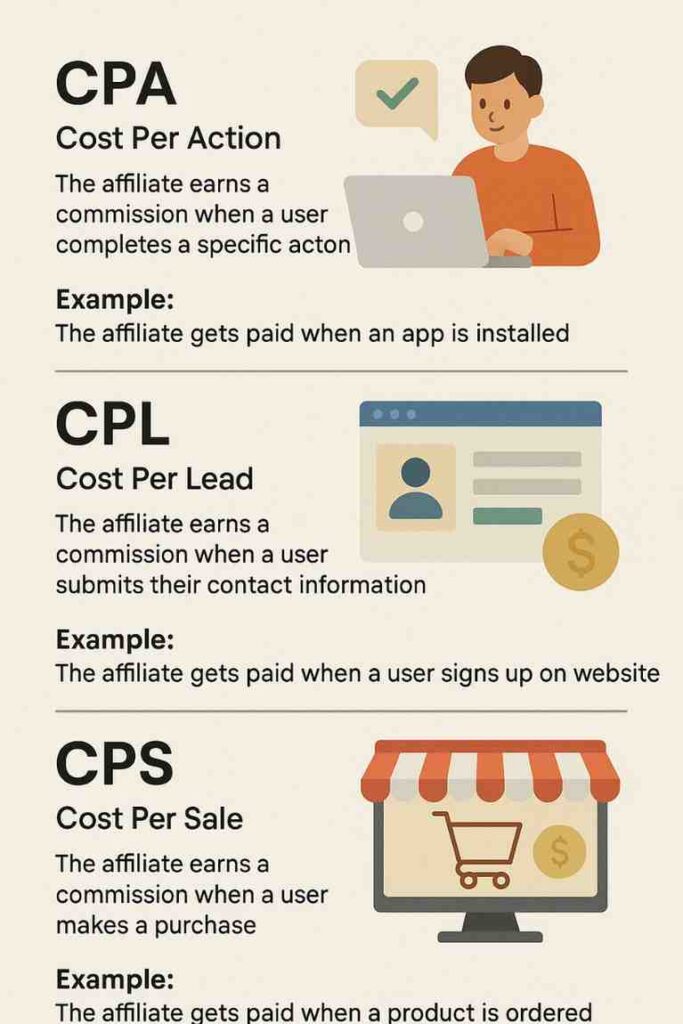
Affiliate marketing is a dynamic and result-driven form of digital marketing in which a business rewards individuals (affiliates) for bringing in traffic, leads, or sales through the affiliate’s marketing efforts. Within affiliate marketing, different payout models define how and when an affiliate is compensated. Among the most commonly used models are CPA (Cost Per Action), CPL (Cost Per Lead), and CPS (Cost Per Sale).
Understanding these models is essential for both merchants and affiliates to optimize their campaigns effectively. Each model represents a different level of engagement from the consumer and carries varying levels of risk and reward for the parties involved.
In this comprehensive explanation, we will define CPA, CPL, and CPS in affiliate marketing, explore how each model functions, discuss their benefits and challenges, and provide real-life examples to illustrate their practical application.
1. What is CPA (Cost Per Action) in Affiliate Marketing?
Definition:
CPA stands for Cost Per Action (or sometimes Cost Per Acquisition). It is a broader affiliate marketing model where the affiliate earns a commission when the referred user completes a specific predefined action. This action can range from making a purchase, filling out a form, signing up for a newsletter, downloading an app, or watching a video.
The term “action” is generic and can be customized based on the advertiser’s goals. That’s what makes CPA one of the most flexible and popular models in affiliate marketing.
How It Works:
-
An affiliate promotes an offer through a tracking link.
-
A user clicks the link and is redirected to the advertiser’s page.
-
If the user performs the required action (such as filling out a form or installing an app), the affiliate gets paid.
Key Characteristics:
-
Flexible: Includes CPL, CPI (Cost Per Install), and CPS as subsets.
-
Conversion-focused: Advertisers only pay when users complete a meaningful action.
-
Risk-controlled: Advertisers avoid wasting money on clicks or impressions that don’t convert.
Example:
A food delivery startup wants new users to download and sign up for its mobile app. They offer a CPA affiliate program paying ₹50 per successful sign-up.
-
An affiliate places the app link in their blog post titled “Top 5 Food Delivery Apps in India.”
-
A user clicks the link, installs the app, and signs up.
-
The affiliate earns ₹50 for that action.
2. What is CPL (Cost Per Lead) in Affiliate Marketing?
Definition:
CPL stands for Cost Per Lead. It is a subtype of the CPA model. In CPL, the affiliate is rewarded when the user they refer submits their contact information — often through a form — thereby becoming a “lead” for the business.
Leads are potential customers who have shown interest in a product or service but haven’t made a purchase yet. This model is especially popular with service providers, education companies, real estate firms, and B2B businesses.
How It Works:
-
The affiliate promotes a lead generation offer, such as a free eBook download or webinar registration.
-
A user clicks the link and submits a form with basic contact details (name, phone number, email).
-
The advertiser captures this data for future sales efforts.
-
The affiliate earns a fixed commission per lead.
Key Characteristics:
-
High conversion potential: Users don’t have to make a purchase — just share basic info.
-
Ideal for long sales cycles where nurturing leads is necessary.
-
Affiliates are paid quickly and reliably, even if a sale isn’t made.
Example:
A university launches an affiliate program offering ₹100 per student inquiry.
-
An affiliate runs Facebook ads promoting a “Download Free College Admission Guide” campaign.
-
Interested students fill out a form with their name, phone number, and email.
-
For each completed form, the affiliate earns ₹100.
If the campaign generates 300 leads, the affiliate earns ₹30,000 — regardless of whether any of the students actually enroll.
3. What is CPS (Cost Per Sale) in Affiliate Marketing?
Definition:
CPS stands for Cost Per Sale. This is one of the oldest and most common affiliate marketing models, also known as Pay Per Sale (PPS). In CPS, affiliates are paid a commission only when the referred user makes a successful purchase.
The affiliate earns a percentage of the sale amount or a fixed fee, depending on the terms set by the advertiser.
How It Works:
-
An affiliate promotes a product (e.g., a book, software, or physical item) via a special tracking link.
-
A user clicks on the link and purchases the item.
-
The affiliate earns a share of the revenue from the sale.
Key Characteristics:
-
Low risk for advertisers: Payment is made only when a transaction occurs.
-
Encourages high-intent referrals.
-
Commission size often correlates with the product price and industry margins.
Example:
An e-commerce platform offers a 10% CPS commission on electronics.
-
An affiliate creates a YouTube video comparing smartphones and includes a link to one of the featured products.
-
A viewer clicks the affiliate link and purchases a smartphone worth ₹25,000.
-
The affiliate earns ₹2,500 (10% of the sale value).
If the affiliate refers five sales in a day, they earn ₹12,500 for that day.
Comparison Between CPA, CPL, and CPS
| Feature | CPA (Cost Per Action) | CPL (Cost Per Lead) | CPS (Cost Per Sale) |
|---|---|---|---|
| Action Required | Any predefined action (sale, lead, install, etc.) | User submits a form or basic info | User completes a purchase |
| Ease of Conversion | Moderate to High | High (no purchase needed) | Low to Moderate (requires purchase) |
| Affiliate Risk | Moderate | Low | High |
| Advertiser Risk | Low | Moderate | Very Low |
| Earning Potential | Depends on the action | Usually lower per conversion | High commissions on each sale |
| Popular Use Cases | App installs, trials, downloads | Insurance, real estate, education | E-commerce, SaaS, online stores |
Advantages of CPA, CPL, and CPS Models
Advantages of CPA:
-
Flexibility in choosing the conversion action.
-
Aligns closely with specific campaign goals.
-
High scalability across industries.
Advantages of CPL:
-
Easier for users to convert since no payment is required.
-
Allows advertisers to build email lists and nurture prospects.
-
Effective for high-ticket services or B2B industries.
Advantages of CPS:
-
Highly profitable per transaction.
-
Promotes serious consumer intent.
-
Trusted and widely accepted in the affiliate world.
Challenges and Limitations
CPA Challenges:
-
Defining meaningful actions that result in actual customer interest.
-
Potential for fraud — bots or fake users completing basic tasks.
CPL Challenges:
-
Not all leads convert into customers.
-
Lead quality can vary, affecting advertiser ROI.
-
Requires strict validation rules to avoid fake submissions.
CPS Challenges:
-
Difficult to convert traffic into sales.
-
Requires more persuasive content, trust, and marketing skills.
-
Affiliates may earn nothing if users don’t complete the purchase.
Real-World Scenario Involving All Three Models
Let’s say a company, EduGrow, offers online courses in programming and digital marketing. They implement all three affiliate models.
-
CPA – They run a campaign offering ₹30 for every user who signs up for a free webinar.
-
CPL – They offer ₹100 for every user who fills out a detailed inquiry form about their courses.
-
CPS – They offer a 20% commission on every course purchase. If a course costs ₹5,000, the affiliate earns ₹1,000 per sale.
A blogger, techcoach.in, joins the affiliate program and promotes EduGrow’s offerings:
-
100 users sign up for the webinar (CPA) = ₹3,000
-
40 users submit inquiries (CPL) = ₹4,000
-
10 users buy a course (CPS) = ₹10,000
Total affiliate earnings = ₹17,000, leveraging all three models.
Conclusion
In affiliate marketing, CPA, CPL, and CPS are three foundational commission structures that define how affiliates are paid and how advertisers manage their performance-based marketing strategies.
-
CPA (Cost Per Action) provides flexible options based on any action deemed valuable by the business.
-
CPL (Cost Per Lead) is ideal for generating warm leads and building pipelines for long-term conversions.
-
CPS (Cost Per Sale) offers the most direct path to revenue but requires greater effort to persuade customers to purchase.
Each model serves a distinct purpose and is best suited for specific industries, products, and marketing goals. Affiliates must understand their audience and capabilities to select the most profitable model, while advertisers should align compensation with meaningful business outcomes. When used strategically, CPA, CPL, and CPS models can create win-win opportunities for both sides — driving conversions, boosting brand exposure, and generating income.